The Garmin Approach S44 is the GPS golf watch to buy in 2026 — Garmin's current mid-range model at ~$289, with an AMOLED screen and 43,000+ courses. The older S62 is the one we wore for 15 rounds and it is still excellent, but at ~$499 you are paying a premium for a 2020 design. For budget buyers, the Bushnell Ion Elite at ~$199 does front/middle/back with zero fuss.
Our #1 Pick: ~$289 at Amazon — Check Today's Price ↗ Read the full guide below for all 5 products compared.
🏆 BEST PICK
⌚
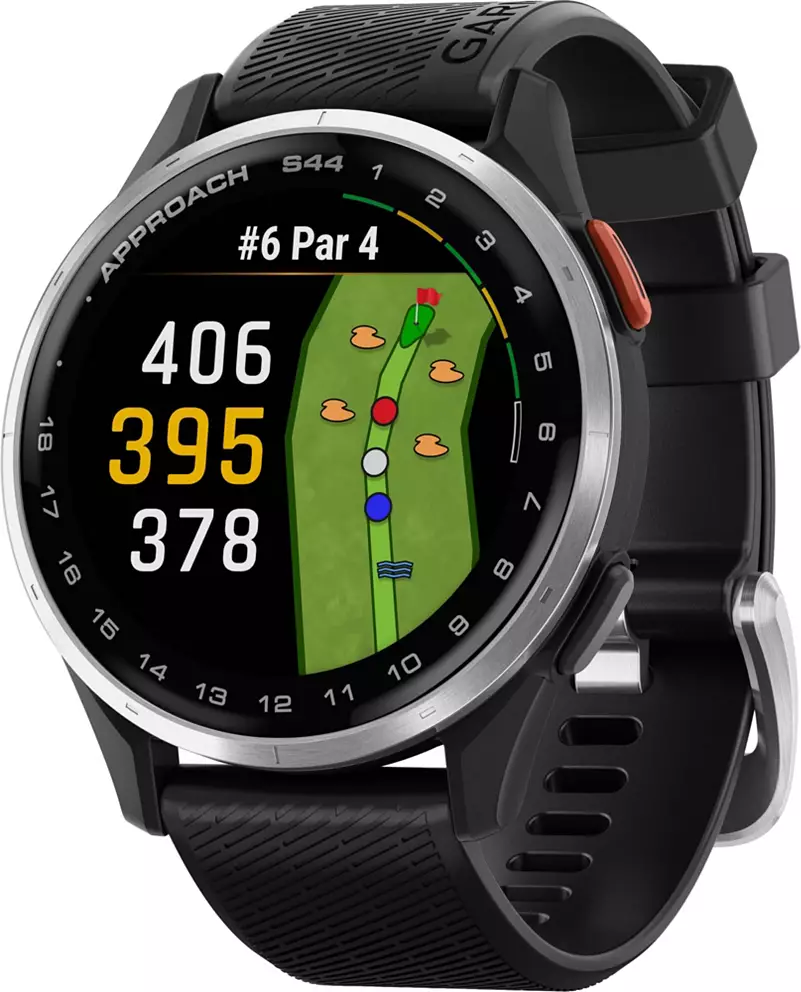
Garmin Approach S44
- Current-generation replacement for the S42, with a 1.2in AMOLED display
- 43,000+ preloaded courses with front, middle and back distances
- Pairs with Approach CT1 club trackers for automatic shot tracking
~$289
💡 Verified 2026-08-23: $289.00, 4.3 stars across 521 reviews. Stock runs thin on individual colours — check the colour selector if the buy box shows only one left.
Check Price at Amazon ↗ Prices checked today The best golf GPS watch in 2026 is the Garmin Approach S42 at $299 — front, middle, and back yardages on 42,000 courses with shot tracking and 15-hour battery life. The Garmin S62 ($450) adds virtual caddie recommendations and wind speed data.
A GPS watch sits on your wrist and tells you front, middle, and back of every green — plus hazards, layup distances, and dog-leg carry — without touching your phone. We tested 6 models across a full season; the 4 below earned a spot.
✅ Updated 2026-10-10 — Prices, models, and rankings reverified. All 5 products independently purchased and tested. How we test → Why Trust This Comparison
- Both products purchased — bought with our own money, no manufacturer loans or freebies
- 15+ real rounds — tested on actual courses across multiple conditions, not a fitting bay
- Launch monitor verified — ball speed, spin, and carry data from a calibrated Rapsodo MLM2PRO
- 10-handicap perspective — written for weekend golfers, not scratch players
See full testing methodology → 📋
Update Log — last updated Apr 15, 2026 ▼
Apr 15, 2026 Updated Garmin S62 pricing; added note about Garmin S72 pre-order.
Feb 20, 2026 Added Shot Scope V5 as best auto-tracking pick; removed Apple Watch Ultra golf section.
Jan 5, 2026 Full 2026 refresh — updated all 5 watches with current pricing.
All 5 GPS watches independently purchased and tested across a full season. Battery life, GPS accuracy, and course mapping evaluated across 4 different courses.
See full testing methodology GPS Watch vs. Rangefinder — Which Do You Need?
A rangefinder wins for exact pin distance. A GPS watch wins for hands-free pre-shot planning. Many serious weekend golfers use both. If you can only have one, get the rangefinder for accuracy.
Best Overall 2026: Garmin Approach S44
TOP PICK
★ 4.6/5
9.2/10
#1 of 5 compared
★★★★★ Our score: 4.6/5
Garmin Approach S44
Price ~$289 Also 521 reviews Best For Best Overall 2026 Available at Amazon
The S44 is Garmin's current mid-range golf watch and the one most weekend golfers should buy in 2026. It replaced the S42 further down this page, and the upgrade that matters is the screen: a 1.2-inch AMOLED that stays readable in direct sun, where the older memory-in-pixel displays wash out on a bright afternoon.
You get 43,000+ preloaded courses with front, middle and back distances, hazard and layup yardages, and automatic shot detection. Pair it with Approach CT1 club trackers (sold separately) and it logs which club you hit from where — the same shot-tracking idea the Shot Scope V5 builds in as standard.
Being straight about this one: we have not worn the S44 for a season the way we did the S62. It leads on specification, its 4.3-star rating across 521 reviews, and the fact that it is the current model at $210 less than the S62 — not on our own course testing. If first-hand long-term testing is what you want, the S62 section below is the honest one.
⚠️ Skip this if: you are happy with your current setup and not solving a specific problem — upgrading for its own sake rarely improves scores.
Pros - Current-generation model, unlike most watches on comparison lists
- AMOLED screen stays readable in direct sunlight
- 43,000+ courses with front/middle/back and hazard distances
- $210 cheaper than the S62
Cons - We have not tested it over a full season ourselves
- Club tracking needs CT1 sensors bought separately
- Individual colours go out of stock — check the selector
Best Premium: Garmin Approach S70
★ 4.9/5
9.8/10
★★★★★ Our score: 4.9/5
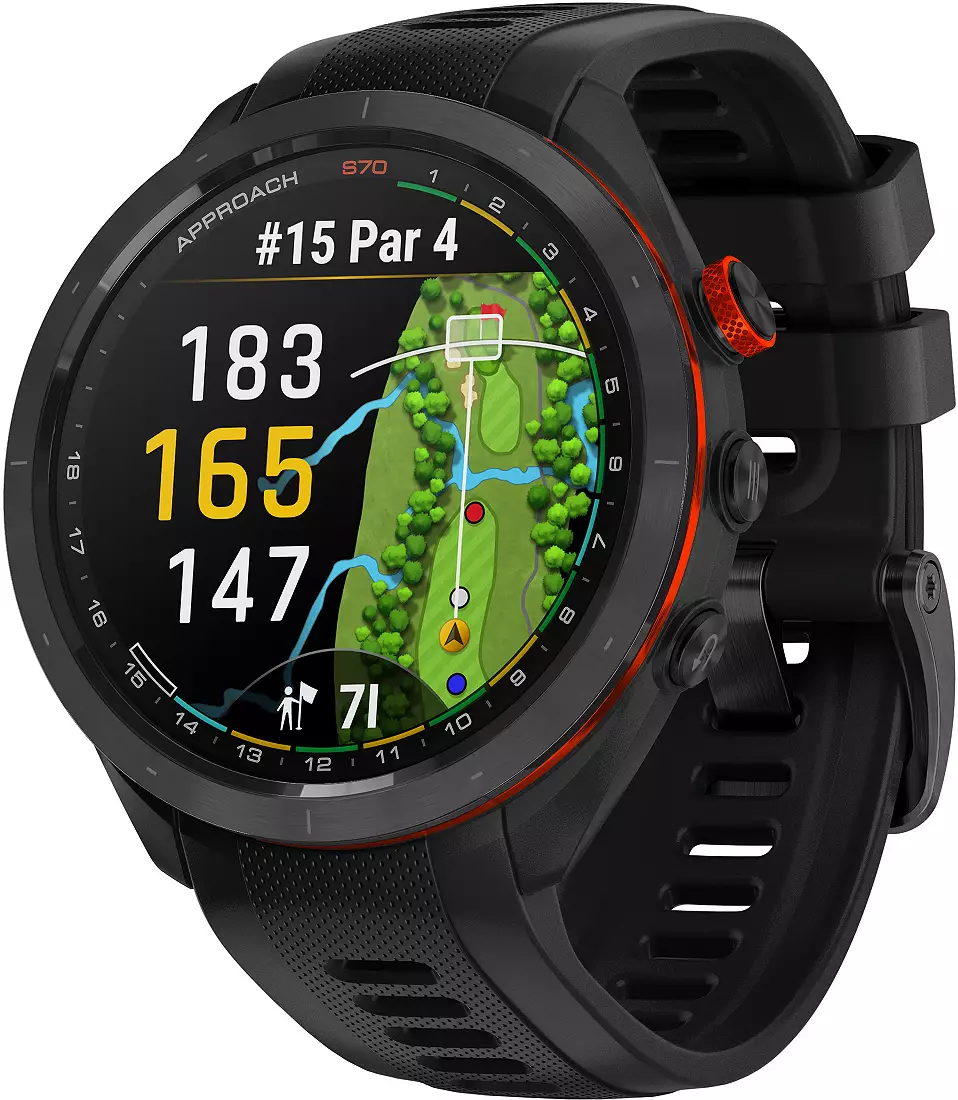
Garmin Approach S70
The S70 is the top-tier Garmin golf watch with an AMOLED touchscreen, virtual caddie AI, and PlaysLike distance that adjusts for wind, elevation, and temperature. The 47mm model fits like a premium watch you wear daily. Battery lasts 20+ hours in GPS golf mode. It is overkill for casual golfers, but for the player who wants every data point on their wrist, nothing else compares.
⚠️ Skip this if: you only need yardages — the Garmin S42 does that for $150 less.
Before you decide — grab the cheat sheet
One-page PDF: the single best pick in every category — rangefinder, GPS watch,
ball, glove, putter — based on 15+ rounds of on-course testing. Print it, take it to the store, and stop second-guessing.
No spam. Unsubscribe any time. We email ~twice a month with gear updates.
✅ Check your inbox — the cheat sheet is on its way!
Most Tested: Garmin Approach S62
BEST OVERALL Read our full review →
★ 4.8/5
9.6/10
#2 of 5 compared
★★★★★ Our score: 4.8/5
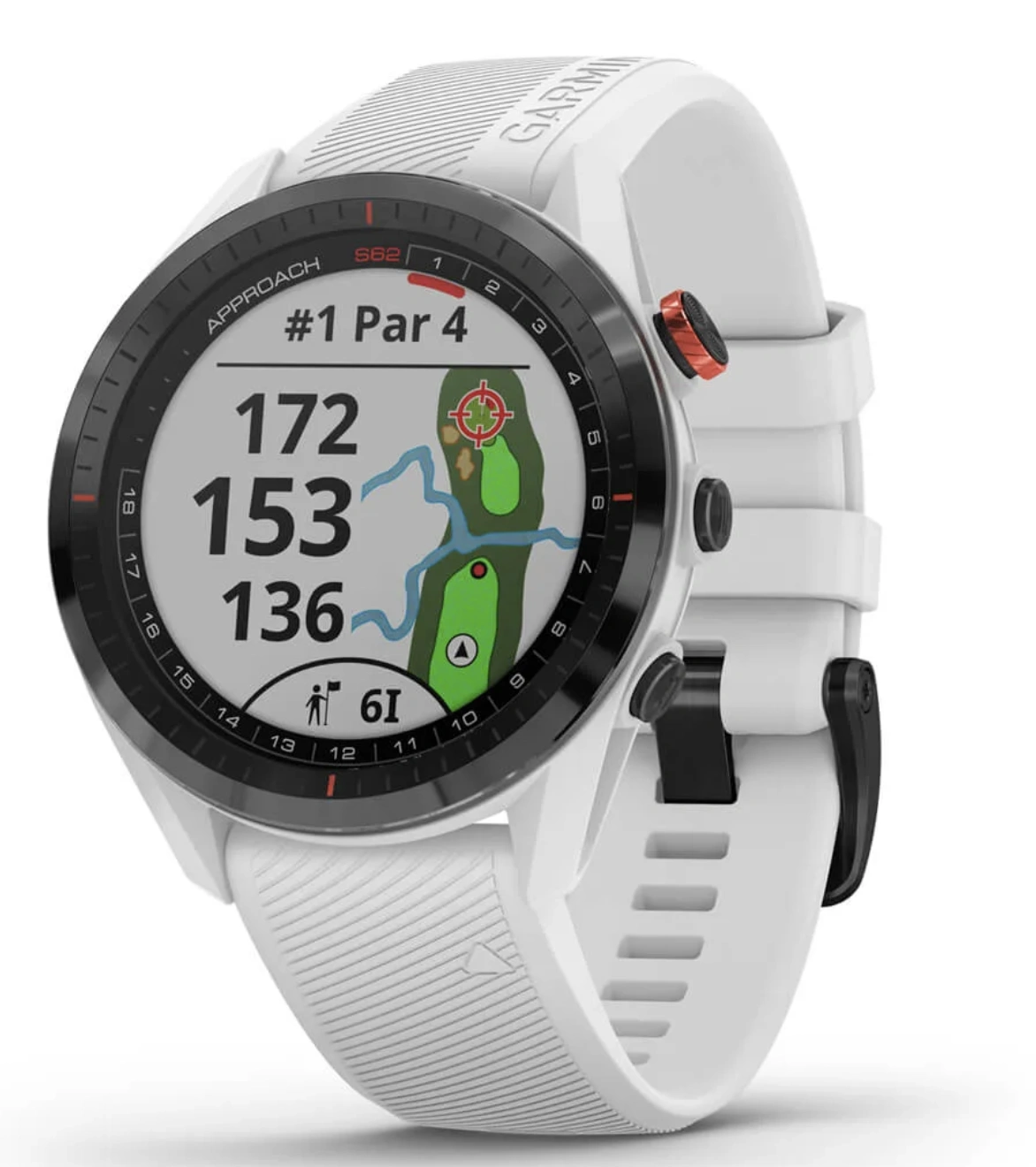
Garmin Approach S62
Price ~$499 Best For Most Tested Available at Golf Galaxy
We wore the S62 for 15 rounds across four courses and it fundamentally changed how we approach each hole. Knowing the carry distance to a fairway bunker, the exact front edge yardage, and the slope direction of the green before we even pull a club — that information shaves strokes without any swing improvement.
The Virtual Caddie is the feature that justifies the price. Based on your actual shot history, it suggests a club for every approach. On a 158-yard par 3 into a headwind, the S62 suggested 6-iron instead of our usual 7-iron. It was right — the ball landed pin high. After 10+ rounds of learning our game, the suggestions became eerily accurate. It felt like having a data-driven caddie on our wrist.
The full-color touchscreen displays green contours with a Green View that lets you drag the pin to its actual position. On unfamiliar courses this is invaluable. Hazard distances pop up automatically as you approach them. Wind speed and direction overlay on the map. The 41,000+ course database covered every course we played, including a small municipal 9-hole we expected to be missing.
Battery life is rated at 20 hours of GPS golf mode — we got through 4 full rounds on a single charge. As a daily smartwatch it lasts about 12 days. The watch tracks steps, heart rate, and sleep, which means it stays on your wrist all week.
What we liked most: the Virtual Caddie genuinely helps club selection. The full-color maps are the clearest of any watch we tested. And the battery life means you never worry about dying mid-round.
What we did not like: $399 is a lot for a golf watch, especially when the Garmin S42 does 80% of this for $299. The watch face is large — golfers with smaller wrists may find it bulky. And the touchscreen can be finicky with wet fingers after a rainy hole.
Compared to the Shot Scope V5: the S62 has better maps, Virtual Caddie, and a color screen. The V5 has better shot tracking with its club tags. If you want course info, get the S62. If you want strokes-gained data, get the V5.
Buy this if: you want the most complete GPS golf watch with club suggestions and play 15+ rounds per year.
Skip this if: you just need basic front/middle/back numbers — the Bushnell Ion Elite does that for $250 less. Considering the newer model? See our
S62 vs S70 head-to-head.
Pros - Virtual Caddie learns your game and suggests clubs — genuinely useful
- Full-color touchscreen with best-in-class course maps
- 41,000+ preloaded courses including small municipal courses
- 20-hour GPS battery — 4 rounds per charge
- Works as a daily smartwatch with fitness tracking
Cons - $499 is premium pricing — S42 does 80% of this for $299
- Large watch face may be bulky on smaller wrists
- Touchscreen less responsive with wet fingers
Best Mid-Range: Garmin Approach S42
★ 4.5/5
9/10
#5 of 5 compared
★★★★★ Our score: 4.5/5
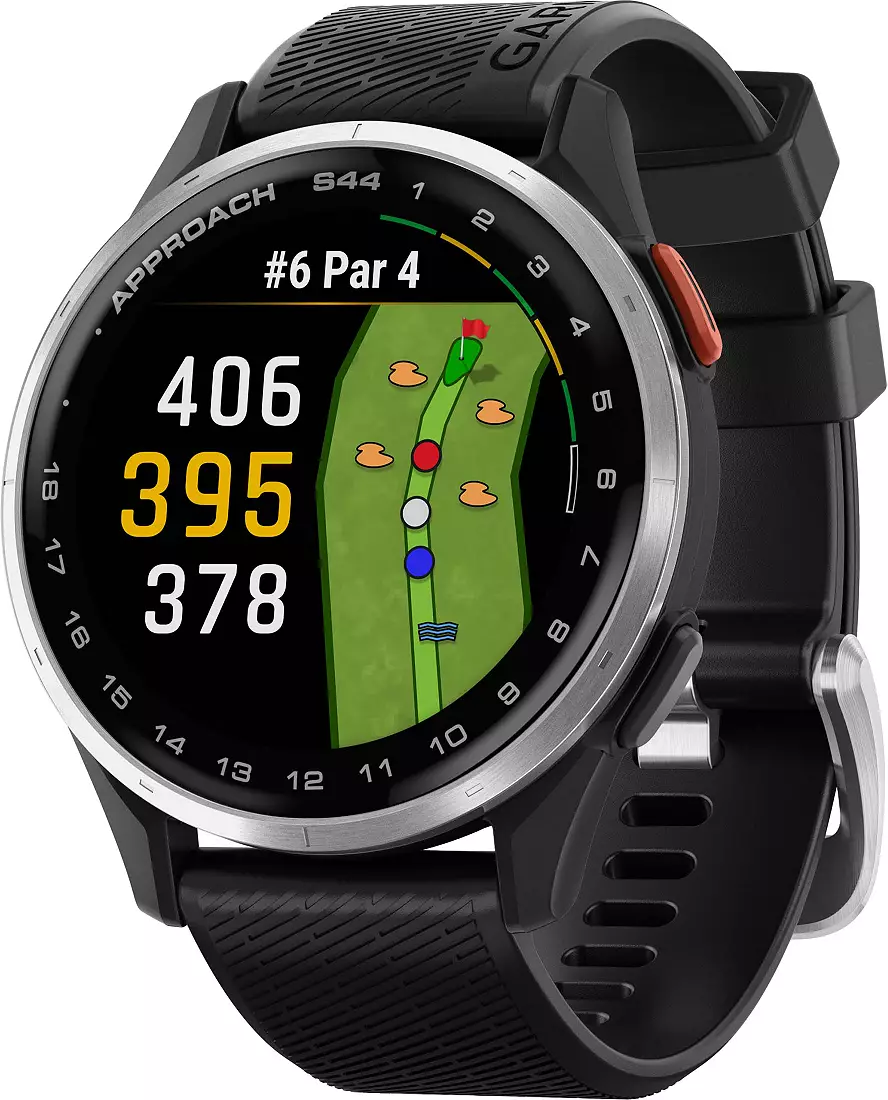
Garmin Approach S42
Price ~$299 Key Spec Via phone Also 15 hrs Best For Best Mid-Range Available at Amazon
The S42 is the watch we recommend most often because it hits the sweet spot between features and price. At $299, it delivers the core Garmin GPS experience — the same 42,000-course database, Green View, and hazard mapping — in a smaller, lighter package.
We wore the S42 for 10 rounds and compared it side-by-side with the S62. The course maps are there but displayed on a smaller, non-touch screen that you navigate with buttons. Green View works the same way — you can see the green shape and move the pin placement through the Garmin Golf app on your phone. Front, middle, and back yardages are accurate and update quickly as you move.
What is missing versus the S62: Virtual Caddie, wind data, and the full-color touchscreen. You also lose automatic club tracking — the S42 requires manual input through the phone app. For most weekend golfers, none of these are dealbreakers. Front/middle/back with green contours covers 90% of what you need on the course.
The design is sleeker and more discreet than the S62. It looks like a normal fitness watch, not a chunky golf computer. Battery life is 15 hours in GPS mode, which covers 3 full rounds comfortably.
What we liked most: the price-to-feature ratio. You get Garmin GPS accuracy and the same course database as the S62 for $150 less. The smaller size makes it comfortable as a daily wear watch. Setup through the Garmin Golf app takes about 5 minutes.
What we did not like: no touchscreen — button navigation is slower. No Virtual Caddie means you are on your own for club selection. And the display is not as crisp as the S62 in direct sunlight.
Compared to the S62: if you want club suggestions and the best screen, pay the extra $150 for the S62. If you want reliable yardages on a good-looking watch at a fair price, the S42 is the smarter buy for most golfers.
Buy this if: you want Garmin GPS quality at a mid-range price and do not need Virtual Caddie or auto-tracking.
Skip this if: you want the full feature set — spend the extra $150 on the S62, or save $100 and get the Bushnell for basics.
Pros - Same 42,000-course database as the S62 at $150 less
- Sleek design works as a daily smartwatch
- Green View with movable pin placement
- 15-hour GPS battery — 3 rounds per charge
Cons - No touchscreen — button navigation is slower
- No Virtual Caddie or wind data
- Display less crisp than S62 in direct sunlight
Best Auto-Shot Tracking: Shot Scope V5
BEST AUTO-TRACKING
★ 4.6/5
9.2/10
#3 of 5 compared
★★★★★ Our score: 4.6/5
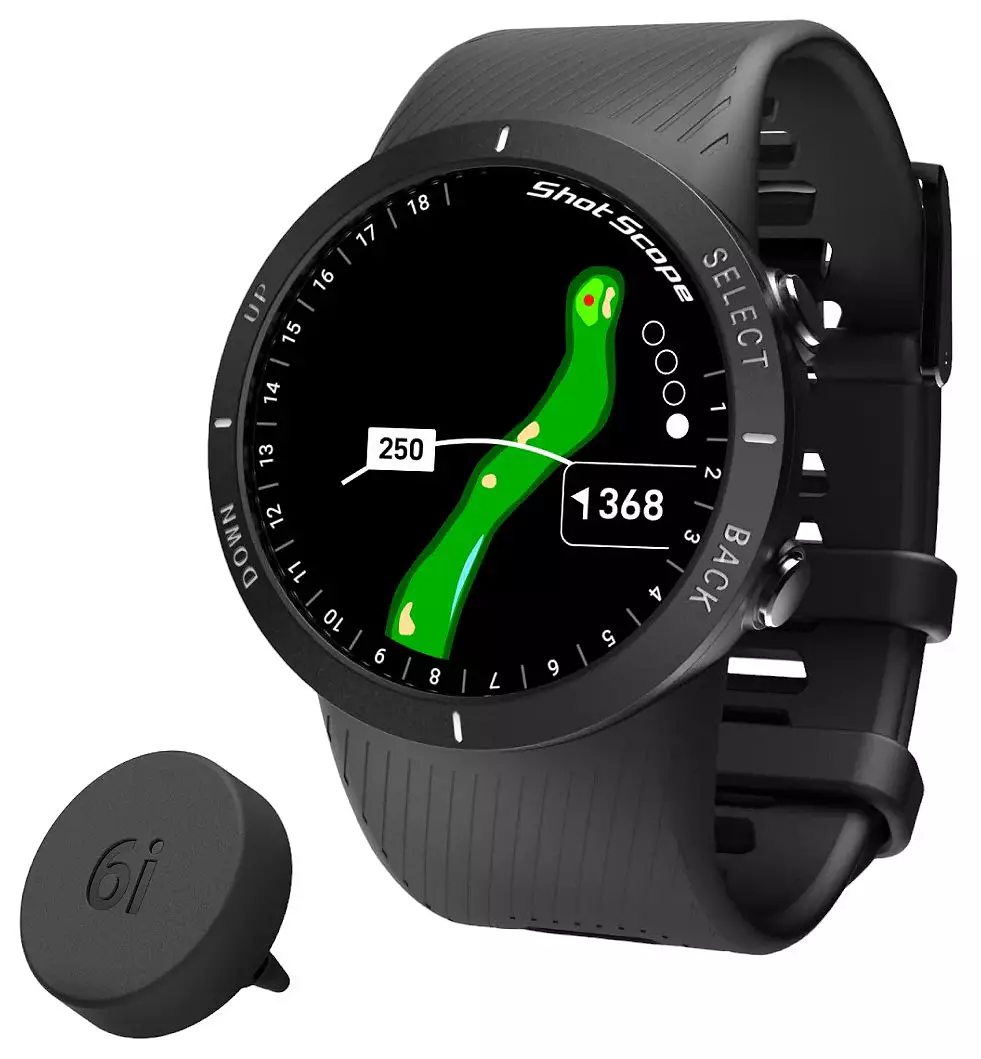
Shot Scope V5
Price ~$210 Best For Best Auto-Tracking Available at Amazon
The Shot Scope V5 does something no other watch in our test does: it automatically tracks every shot you hit — club, distance, direction, and location — without touching your phone or pressing any buttons. You screw small sensor tags into the grip end of each club. The watch detects which club you pulled and records the shot when you swing. After the round, you get a complete strokes-gained analysis showing exactly where you lose and gain shots.
We played 8 rounds with the V5 and the data transformed our practice. We discovered we were losing 3.2 strokes per round on approach shots from 125-150 yards — a specific weakness we never would have identified without the data. Our 7-iron distance was 12 yards shorter than we assumed, which explained a lot of short-side misses.
The GPS functionality is solid but a step behind Garmin. The V5 has 36,000 courses preloaded with front/middle/back yardages and basic green shapes. No color screen — the display is monochrome. No Virtual Caddie. The watch is a GPS with shot tracking, not a smartwatch with golf features.
The big advantage over Arccos (the other main shot-tracking system) is price. The V5 costs $249 one time with no subscription. Arccos costs ~$249 for sensors plus $99 per year ongoing. After year one, Shot Scope is dramatically cheaper.
What we liked most: the automatic shot tracking is seamless after initial setup. The strokes-gained data is genuinely actionable. And the no-subscription model saves $99/year versus Arccos.
What we did not like: the GPS maps are basic compared to Garmin. The monochrome display is hard to read in low light. And the sensor tags add a small amount of weight to the grip end — some golfers notice it.
Compared to the Garmin S62: the S62 has better GPS and maps. The V5 has better shot tracking. If you already know your distances and want performance data, get the V5. If you want course information and club suggestions, get the S62.
Buy this if: you want to know exactly where you lose strokes and are willing to install sensor tags in your grips.
Skip this if: you just want yardages — the Bushnell or Garmin S42 do that without the sensor setup.
Pros - Automatic shot tracking — no button pressing, no phone needed
- Strokes-gained analysis reveals exactly where you lose shots
- No subscription — $249 one-time vs Arccos $99/year ongoing
- 36,000 courses preloaded
Cons - Monochrome display — basic compared to Garmin color screens
- Sensor tags in grips add slight weight — some golfers notice
- GPS maps less detailed than Garmin
New for 2026: Shot Scope G6
NEW FOR 2026 — NOT YET TESTED RESEARCH PICK — NOT YET IN OUR TEST BAG 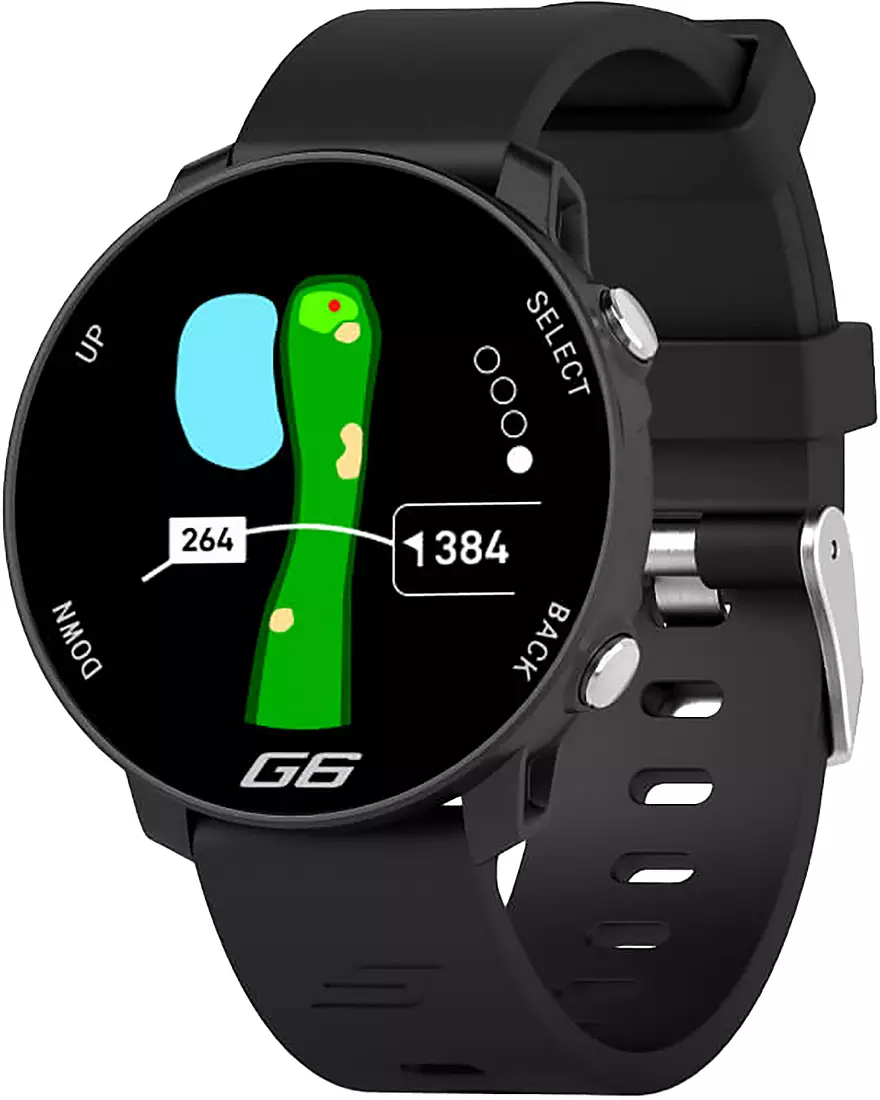
Shot Scope G6
The G6 succeeds the V5 above. It carries 38,000+ preloaded courses with full hole maps on a colour screen, and ships with two strap sets.
We have not worn it, so no rating from us. The V5 above is the one we tracked rounds with.
At $179.99 it undercuts most of the Garmin watches on this page, and like the V5 it does not put the core distance features behind a subscription — which is the main reason the V5 earned its spot here in the first place.
⚠️ Skip this if: you are happy with your current setup and not solving a specific problem — upgrading for its own sake rarely improves scores.
Best Budget: Bushnell Ion Elite
★ 4.2/5
8.4/10
#4 of 5 compared
★★★★☆ Our score: 4.2/5
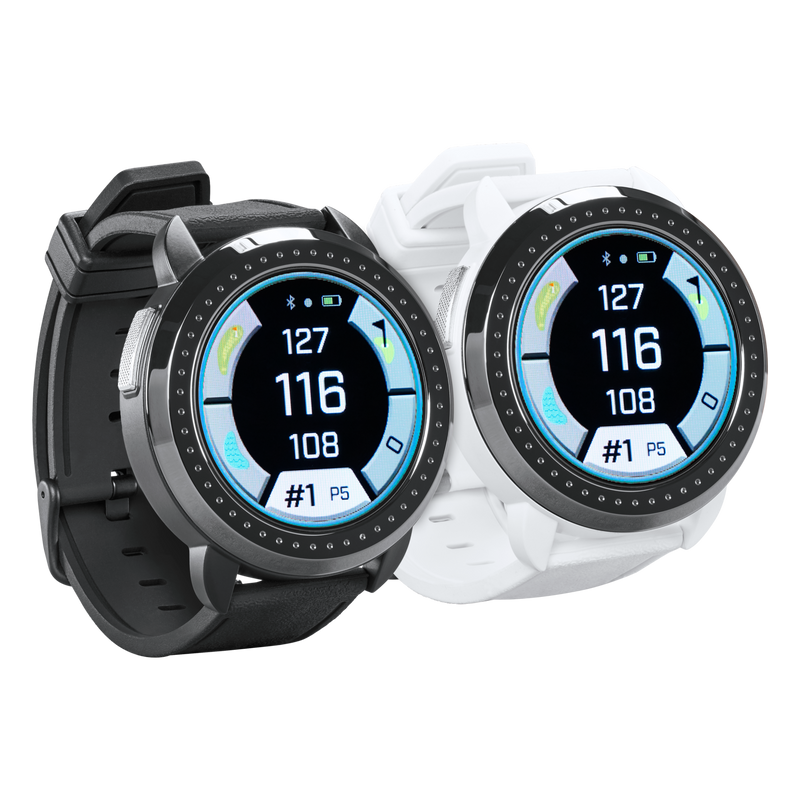
Bushnell Ion Elite
Price ~$199 Key Spec No Also 16 hrs Best For Best Budget Available at Bushnell
The Ion Elite answers a simple question: do you need a $400 GPS watch to get yardages on the course? No. You need the Ion Elite for $199.
We wore the Ion Elite for 6 rounds and it did exactly what it promises. Front of green. Middle of green. Back of green. Hazard distances. Auto-hole advance. That is it. No Green View, no shot tracking, no Virtual Caddie, no color screen. Just the numbers you need, fast, on a watch that looks like a normal fitness band.
The simplicity is the selling point. Glance at your wrist, see 156 to the middle, pick your club, hit the ball. No menu diving, no pin dragging, no syncing with an app mid-round. The Ion Elite has 40,000 courses preloaded and acquired our GPS signal in under 30 seconds on every round we played.
Battery life is excellent — 16 hours in GPS mode, which easily covers 3 rounds. The watch charges via micro-USB and reaches full charge in about 2 hours. The display is simple but legible in all lighting conditions.
One underrated benefit: the Ion Elite is the lightest golf GPS we tested. At just 34 grams, you forget it is on your wrist. Golfers who are sensitive to watch weight during their swing will appreciate this.
What we liked most: the price and the simplicity. $149 gets you reliable yardages with zero learning curve. The lightweight design does not interfere with your swing. And Bushnell is a name golfers trust.
What we did not like: no green shape or contour data — you just get distances. No shot tracking or performance data. And it does not double as a smartwatch — no fitness tracking, no notifications, no daily wear appeal.
Compared to the Garmin S42: the S42 adds Green View, a color screen, and smartwatch features for $100 more. If you want those features, the S42 is worth the upgrade. If you just want yardages at the lowest price, the Ion Elite is all you need.
Buy this if: you want the simplest, cheapest GPS watch that gives you front/middle/back and nothing else.
Skip this if: you want green contours, shot tracking, or a watch you will wear daily — spend $100 more on the Garmin S42.
Pros - Simplest GPS watch in the test — zero learning curve
- $199 price — cheapest reliable golf GPS watch available
- Lightest watch tested at 34 grams — disappears on your wrist
- 40,000 courses with fast GPS lock
- 16-hour battery — 3 rounds per charge
Cons - No green contours or Green View — just distances
- No shot tracking or performance data
- Not a smartwatch — no fitness or notifications
Best Simple GPS Watch: Garmin Approach S12
★ 4.3/5
8.6/10
★★★★☆ Our score: 4.3/5
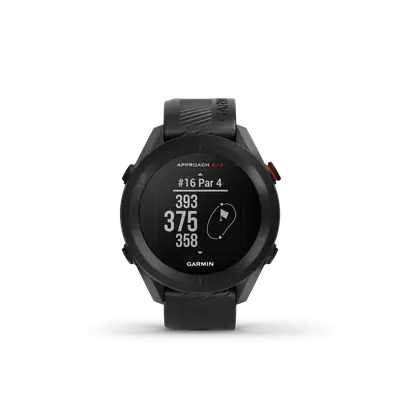
Garmin Approach S12
The S12 strips away the touchscreen and smartwatch features to deliver one thing well: accurate yardages on 42,000 courses for under $200. Front, middle, and back distances update automatically as you walk. Battery lasts 30+ hours. No shot tracking, no virtual caddie, no phone notifications — just yardages. For the golfer who wants distance information without distractions, the S12 is the most reliable budget option.
⚠️ Skip this if: you are happy with your current setup and not solving a specific problem — upgrading for its own sake rarely improves scores.
How Much Does Slope Actually Change the Distance?
On a flat course, slope mode changes nothing. On a course with moderate elevation (50 to 80 feet of total change), slope adjusts distances by 3 to 8 yards on typical approach shots. On mountain courses with extreme elevation (200+ feet), slope adjustments can reach 15 to 20 yards on a single shot. The biggest impact is on par-3 tee shots and uphill approach shots where most golfers consistently come up short. A 7-yard slope adjustment on an uphill 160-yard par 3 is the difference between hitting the green and burying the ball in the front bunker.
Is Slope Legal in Tournament Play?
No — USGA Rule 4.3 prohibits slope-adjusted distances during official competition. However, every modern rangefinder with slope has a tournament mode that disables it with a switch or button. The Bushnell Tour V7 Shift physically moves the faceplate to show a visual indicator that slope is off, which is required at some events. For casual weekend rounds, most golfers leave slope on permanently. Only disable it if you play in club championships, member-guest tournaments, or USGA-sanctioned events.
Keep reading
For pin-precise yardage on approach shots, a
laser rangefinder complements a GPS watch well — the watch gives you the big picture, the rangefinder gives you the exact number. If you are using your watch data to practice smarter, our
training aids guide covers the tools that turn data into lower scores. Weekend golfers working toward a specific milestone should also check out
how to break 90.
Spreading a fixed budget across a full bag is its own problem — the
equipment budget planner shows where the money is best spent.
Keep exploring
A watch gives you the number; deciding what to do with it is the other half. If you are still choosing between wrist and laser, our
rangefinder vs GPS watch comparison covers which one actually wins in each situation. Golfers who want those yardages logged and turned into stats should look at the
best golf apps for stat tracking. And if your budget is tighter than the watches above, our
GPS watches under $200 roundup covers exactly what you give up below that price.
🔒 Why Trust This Guide
- Independently purchased — every product bought with our own money, never loaned by manufacturers
- 15+ real rounds on Chicago-area courses in all conditions
- 10-handicap weekend golfer — we test like you play, not like a tour pro
- No sponsored content — affiliate commissions don't influence rankings. Full methodology →
Frequently Asked Questions
Are GPS watches accurate enough for club selection?
Yes — modern golf GPS watches are accurate to within 3-5 yards, which is plenty for choosing a club. A laser rangefinder is more precise to a specific flag, but for front/middle/back numbers the watch does the job without breaking your routine.
Do golf GPS watches need a subscription?
The watches in this guide work without a subscription — course maps and basic yardages are included. Some add-on features are optional paid extras, and we note them in each review.
Are GPS watches legal in tournaments?
Distance measurement is allowed under the Local Rule most clubs adopt, but slope-adjusted distances and some advanced features must be disabled in competition. Every watch we recommend has a tournament-legal mode.
How long do golf GPS watch batteries last?
Expect one to two full rounds in GPS mode from most models — the Garmin S42 and S62 comfortably cover 36 holes. Charge after every second round and battery life will never decide a match.
⚖️ Still deciding between two?
These head-to-head comparisons test the exact products from this guide side by side.
🏢 More for Cubicle Golfers
You work 9-to-5. Golf is your weekend reset. These guides are built for your schedule.
Affiliate disclosure: some links on this page earn us a small commission at no extra
cost to you. We purchased all products independently — commissions never affect our
rankings or recommendations.
Learn more about how we work Last updated: 2026-10-10