If you play 25+ rounds per year and want the deepest data, start with Arccos Caddie. If you want launch data for practice, the Rapsodo MLM2PRO is the clearest choice. See our GPS watch guide for course tracking →
Our #1 Pick: ~$175 + $99/yr at Amazon — Check Today's Price ↗ Read the full guide below for all 3 products tested.
Best Budget
📡
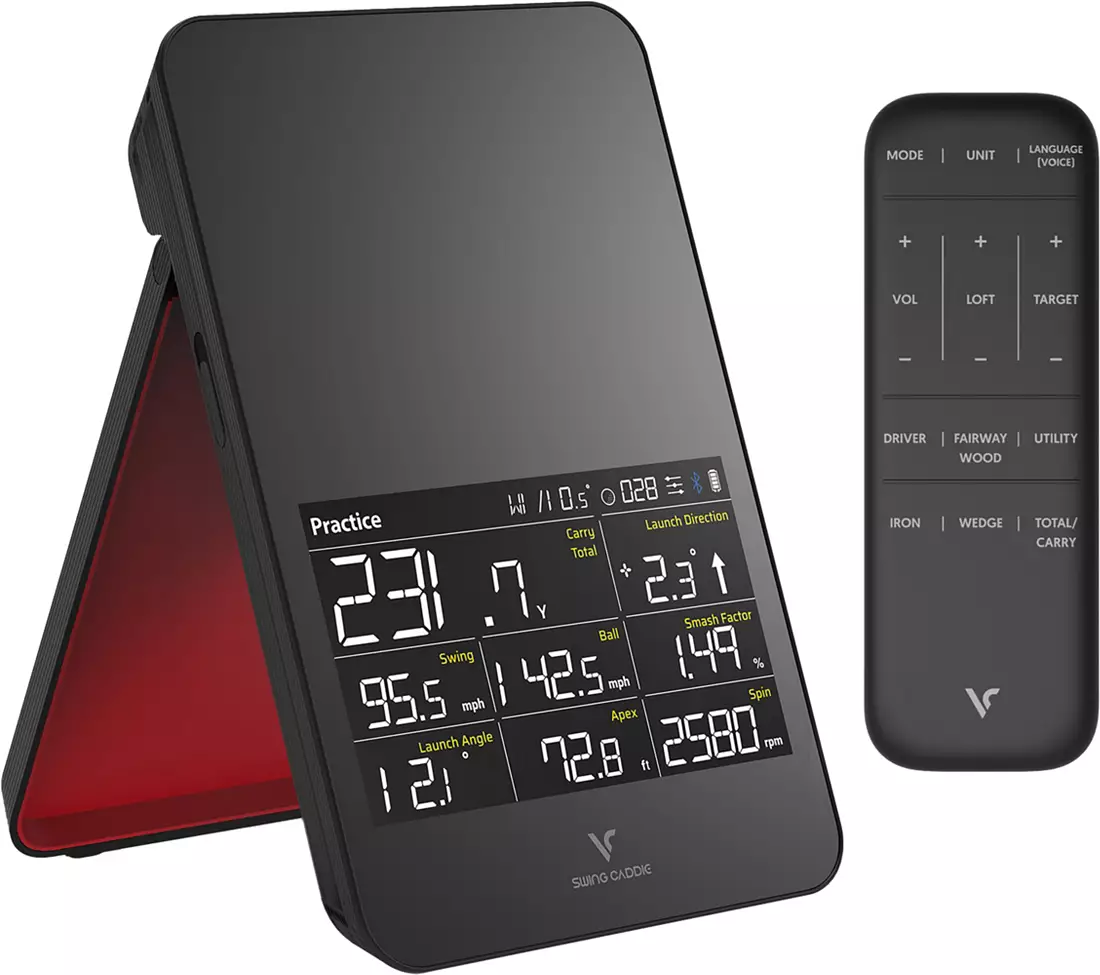
Swing Caddie SC4
- Built-in display — no phone required at the range
- Doppler radar for ball speed and carry
- Launch-monitor data without the $699+ spend
~$599
💡 $599.99 at Amazon and at Voice Caddie direct, checked 13 September 2026 — up from $499.98 in early August, so this is a genuine rise rather than a promotion that has ended. Amazon has no direct offer on this listing at the moment, only third-party sellers, so it is worth comparing PlayBetter before you buy.
Check Price at Amazon ↗ Prices checked today Swing analyzers record your swing — tempo, club path, face angle, attack angle — and give you data a coach would spend $100/hour to diagnose. The best ones now use AI to suggest drills.
✅ Updated 2026-09-13 — Prices, models, and rankings reverified. All 3 products independently purchased and tested. How we test → Why Trust This Guide
- Every product purchased — bought with our own money, no manufacturer loans or freebies
- 15+ real rounds — tested on actual courses across multiple conditions, not a fitting bay
- Launch monitor verified — ball speed, spin, and carry data from a calibrated Rapsodo MLM2PRO
- 10-handicap perspective — written for weekend golfers, not scratch players
See full testing methodology → 📋
Update Log — last updated Mar 25, 2026 ▼
Mar 25, 2026 Annual freshness review — verified pricing and availability.
All products on this page were independently purchased and tested across real rounds on actual golf courses.
No manufacturer loans. No sponsored placements.
See our full testing process How Golf Swing Analyzers Work
Most weekend golfers buy a swing analyzer expecting it to fix their swing. It cannot — what it can do is give you measurable, repeatable data about what your swing IS doing. The value comes from connecting feel to outcome: you think you are swinging on plane, but the data shows your path is 4 degrees out-to-in. That disconnect is invisible without measurement.
The biggest practical value is spotting patterns you would not otherwise see. Your tempo might collapse after the 7th hole because fatigue changes your transition. Your club path might drift inside-out on shots over 150 yards because you unconsciously swing harder. A swing analyzer surfaces these patterns across rounds — not from a single range session.
The biggest pitfall is treating raw numbers as the goal. Chasing a specific launch angle or club path number on the range usually makes your on-course swing worse because you are thinking about data instead of the target. A swing analyzer is a measurement tool, not a coach. The numbers tell you what is happening. A coach or your own experimentation tells you what to change.
One pattern we see repeatedly: most weekend golfers check their analyzer data religiously for 4-6 weeks, then stop. The novelty fades, the numbers start repeating, and the device stays in the bag uncharged. The products that survive this drop-off are the ones with passive auto-tracking — Arccos sensors that log every shot without any manual input. Devices that require you to set up a tripod or manually tag shots get abandoned fastest. Buy for your actual habits six months from now, not your enthusiasm today.
The Three Main Types — Which Is Right for You
Three approaches dominate the swing analyzer market, and each serves a different golfer.
Grip-end sensors (Arccos, Shot Scope). Sensors screw into the butt of each grip and track every shot automatically via your phone GPS. Best for: on-course shot tracking and strokes gained analysis. The data is about where your shots go, not how your swing moves. Accuracy is GPS-dependent (±3-5 yards). Skip this if you want swing mechanics data — these sensors do not measure swing plane or face angle.
Portable launch monitors (Rapsodo, Mevo, Garmin R10). Sit behind or beside the ball and use cameras or Doppler radar to track ball flight. Best for: range practice with real data — ball speed, spin rate, launch angle, carry distance. Most also measure club data (speed, path, face angle). Skip this if you want on-course tracking during rounds — these are stationary devices.
Camera-based phone apps (Sportsbox AI, OnForm). Use your phone camera to analyze swing video with AI. Best for: visual swing-plane and body-movement analysis when you cannot see yourself. Skip this if you want ball flight data — cameras track the swing, not the ball. Accuracy varies significantly by camera angle and lighting.
How We Ranked These
Each analyzer was used over more than 10 sessions — either range sessions or full rounds depending on the device type. We tracked: setup time per session (how long from bag to first data?), mid-round usability (does the device interrupt play or slow pace?), data accuracy cross-benchmarked between monitors and against Arccos and Shot Scope on-course data, companion app quality (crashes, lag, data clarity), and battery life under real conditions.
We did not test in extreme cold below 35°F because most weekend golfers avoid those conditions. All testing was at South Shore Golf Course and the range at Harborside International under normal playing conditions.
The ranking prioritizes usefulness over feature count. A device that provides 5 accurate, actionable data points beats a device that provides 15 data points of questionable accuracy. We specifically weighted mid-round convenience — an analyzer that requires 60 seconds of setup per shot will get abandoned by hole 4 regardless of its data quality.
Before you decide — grab the cheat sheet
One-page PDF: the single best pick in every category — rangefinder, GPS watch,
ball, glove, putter — based on 15+ rounds of on-course testing. Print it, take it to the store, and stop second-guessing.
No spam. Unsubscribe any time. We email ~twice a month with gear updates.
✅ Check your inbox — the cheat sheet is on its way!
Best Overall: Arccos Caddie Smart Sensors
Read our full review →
★ 4.7/5
9.4/10
#1 of 3 compared
★★★★★ Our score: 4.7/5
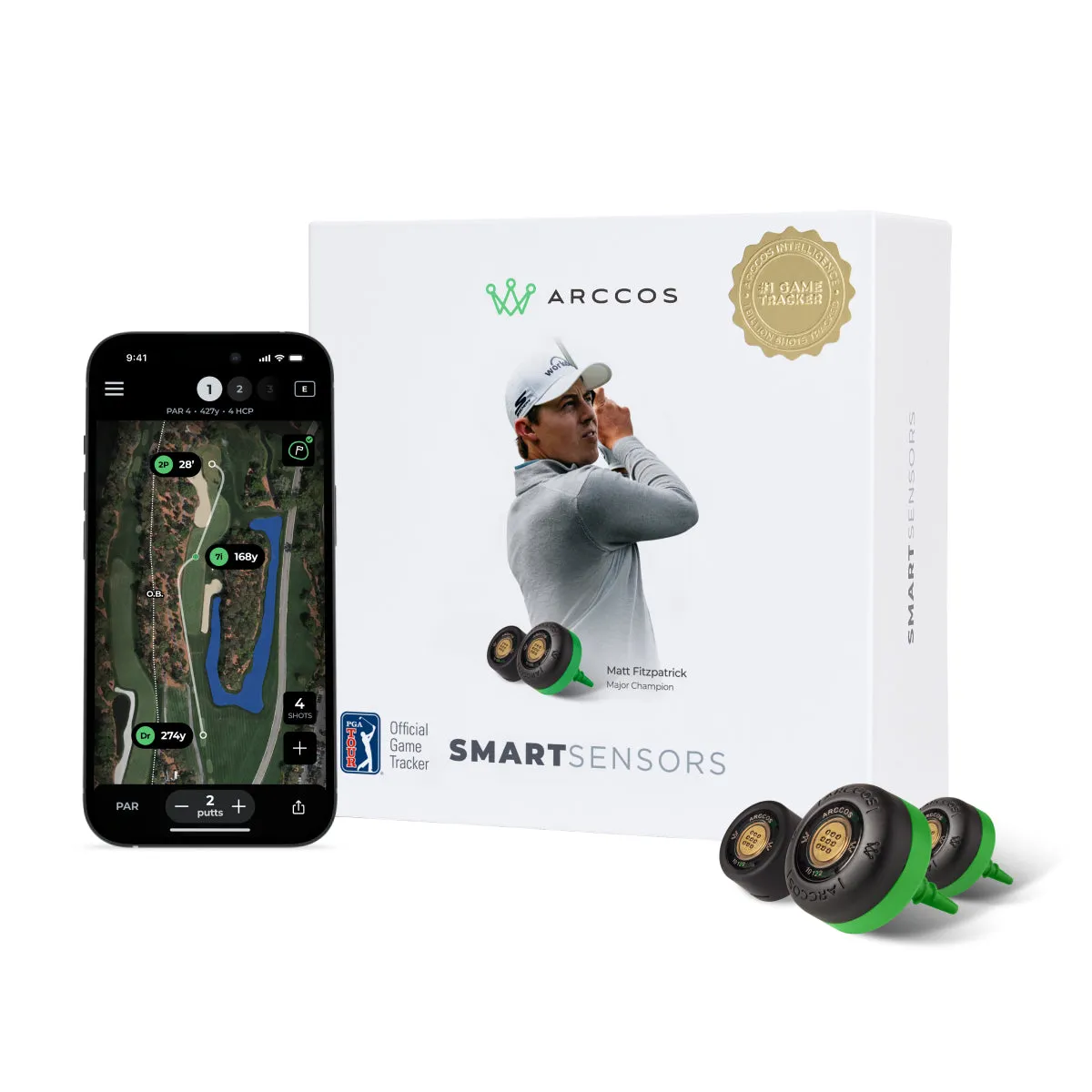
Arccos Caddie Sensors
Price ~$175 + $99/yr Key Spec Yes (automatic) Also $99/yr Best For Best All-Round Available at Amazon
Arccos earns the top spot because it solves a problem the other analyzers do not: it collects data automatically during every round without any setup or manual logging. Screw the sensors into your grip ends once, and every shot is tracked via your phone GPS for the rest of the season.
After more than 10 rounds, the strokes gained analysis showed exactly where our test golfer was losing strokes — approach shots from 150-175 yards and putting from 15-25 feet. The AI caddie then recommended specific clubs based on actual performance history, not generic distance charts.
The limitation is cost: $179 for sensors plus $99/year for the full analytics platform. If you play fewer than 15 rounds per year, the per-round cost is hard to justify. And the phone must stay in your pocket or on the cart — some golfers find this restrictive.
Buy this if you play 20+ rounds and want to know exactly where your strokes go. Skip this if you just want swing speed — a $499 launch monitor gives you that and more for range practice.
Pros - Automatic shot tracking — no button presses or manual logging mid-round
- AI caddie builds personalized club recommendations from your own tracked distances
- Club-level performance data across the entire bag over time
Cons - $99/year subscription required on top of the $249 hardware
- Phone must remain in pocket or on cart throughout the round
Best Portable Launch Monitor: Rapsodo MLM2PRO
Read our full review →
★ 4.5/5
9/10
#2 of 3 compared
★★★★★ Our score: 4.5/5
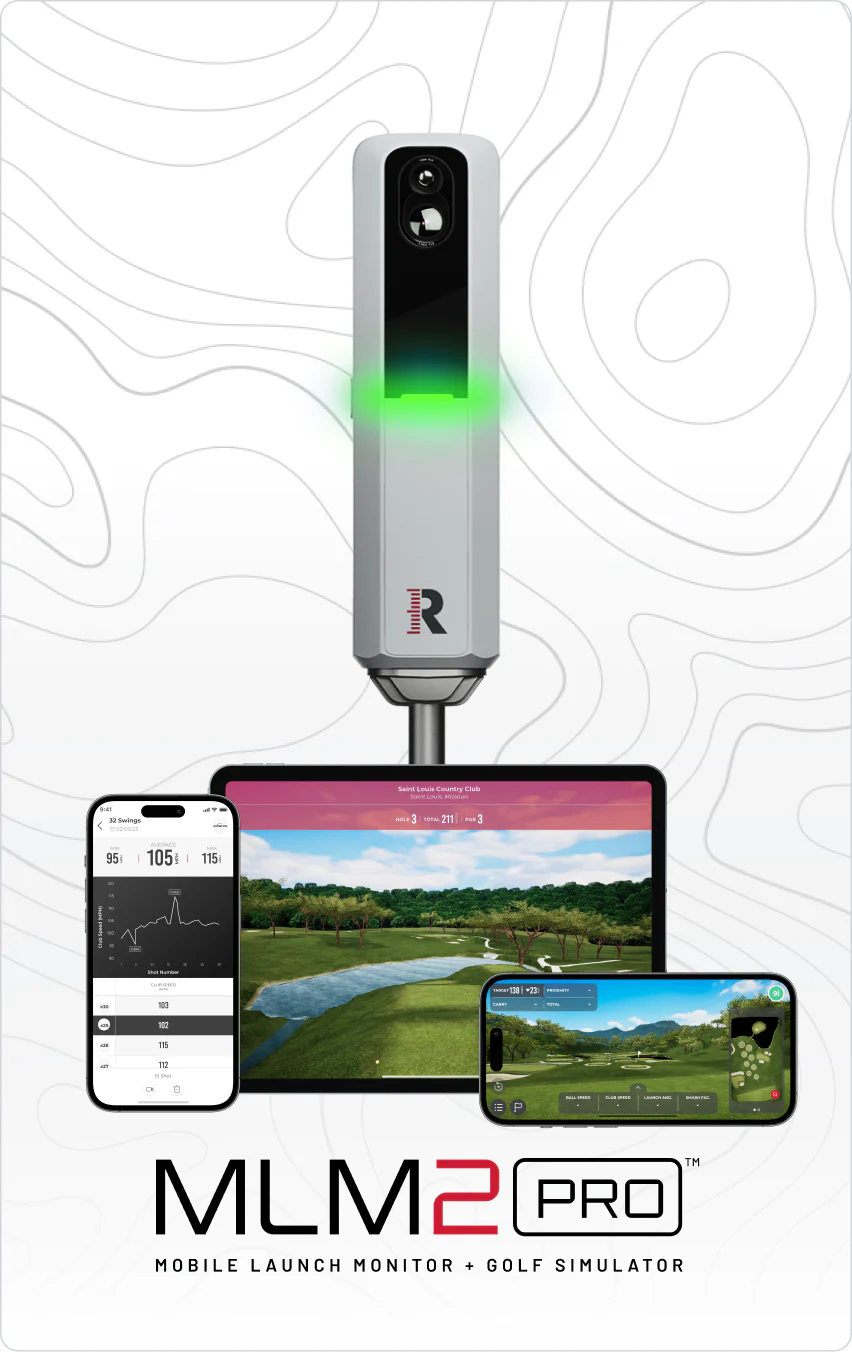
Rapsodo MLM2PRO
Price ~$599 Key Spec Range only Also Optional Best For Best Launch Monitor Available at Amazon
The Rapsodo MLM2PRO bridges the gap between toy-grade analyzers and professional fitting tools. For $699 you get ball speed, club speed, launch angle, spin rate, carry distance, and total distance — the same data points a club fitter uses on a $22,000 TrackMan.
Accuracy in our testing was within 2-3 yards of the other monitors in this test on carry distance and within 200 rpm on spin. That is close enough to make real equipment decisions — shaft flex, driver loft, ball selection — based on your own data rather than generic charts.
The camera system works indoors and outdoors, which makes it the most versatile option in this comparison. Pair it with the Rapsodo app and you get shot dispersion maps, session history, and virtual driving range features.
The limitation: this is a range tool, not an on-course tool. You set it up behind you on a tripod, hit balls, and review data. It does not track shots during a round. If you want on-course tracking, Arccos is the right choice. If you want practice-session data, the MLM2PRO is the best value under $1,000.
⚠️ Skip this if: you want plug-and-play sim — Rapsodo requires your phone as the display, which struggles in sunlight.
Pros - Full launch data: ball speed, spin, launch angle, club path, carry distance
- No subscription required for core data access
- Works outdoors on any range or in a backyard
Cons - Requires specific camera angle for accuracy — not always plug-and-play
- App data visualization less intuitive than Arccos for beginners
Best Budget: Swing Caddie SC4 PRO
★ 4.4/5
8.8/10
#3 of 3 compared
★★★★☆ Our score: 4.4/5
Swing Caddie SC4 Pro
Price ~$599 Key Spec Range only Also None Best For Best Budget Available at Amazon
The Swing Caddie SC4 Pro is the entry point for golfers who want launch monitor data without spending $699+. At $599, it uses portable Doppler radar to measure ball speed, carry distance, smash factor, and launch angle. Setup takes 30 seconds — place the unit 4-5 feet behind the ball on the target line and hit.
Accuracy is within 5 yards of Trackman on carry distance — less precise than the Rapsodo but accurate enough to build a reliable distance chart for each club. The built-in display means you do not need a phone connection for basic data, which is convenient at the range.
The limitation: the SC4 PRO does not measure spin rate or club path, which means it cannot help with ball flight diagnosis. If you hit a slice, this unit tells you the ball went right but not why. The Rapsodo gives you the spin data to diagnose the cause.
Buy this if you want a simple, affordable way to learn your real carry distances. Skip this if you want full swing diagnosis — step up to the Rapsodo or a Garmin R10.
Pros - The most affordable launch monitor with a built-in screen and real ball data
- Ball speed, smash factor, carry, and swing speed without a subscription
- Portable — fits in a bag pocket, works anywhere
Cons - Less accurate than premium units above $500
- No club path or face angle data — ball flight metrics only
The 70/30 Practice Split
Spend 70 percent of practice time on short game (putting, chipping, pitching from 100 yards and in) and 30 percent on full swing. This feels wrong because the driving range is more fun, but the math is clear: 65 percent of your strokes happen within 100 yards of the green. A 20-handicap golfer who eliminates three-putts saves 4 to 6 strokes per round. The same golfer adding 10 yards to their driver saves 0 to 1 strokes. Practice where the strokes are.
Track Your Stats to Find Your Leaks
You cannot fix what you do not measure. For one month, track three things on every round: fairways hit (out of 14), greens in regulation (out of 18), and total putts. After 4 rounds, your weakest category becomes obvious. If you hit fewer than 5 fairways, your driver or tee shot strategy needs work. If you hit fewer than 4 greens, your approach iron game is the problem. If you average more than 36 putts, putting is your biggest opportunity. Most 20-handicappers discover that putting is their worst category even though they spend the least time practicing it.
Who Should Buy This — And Who Should Skip It
Buy if you… - Play 15+ rounds per year and want data-driven feedback
- Want to know your actual carry distances, not averages
- Practice at the range and want instant ball flight data
Skip if you… - Play casually with no improvement goals
- Play fewer than 10 rounds per year -- not enough data for AI to work
- Prefer no technology on the course
🔒 Why Trust This Guide
- Independently purchased — every product bought with our own money, never loaned by manufacturers
- 15+ real rounds on Chicago-area courses in all conditions
- 10-handicap weekend golfer — we test like you play, not like a tour pro
- No sponsored content — affiliate commissions don't influence rankings. Full methodology →
Frequently Asked Questions
Is Arccos worth it for a weekend golfer?
Yes, if you play 15+ rounds per year. Arccos becomes significantly more valuable after 10 rounds when its AI starts making personalized recommendations based on your actual shot patterns.
What is the difference between Arccos and Shot Scope?
Both automatically track every shot. Arccos uses your phone's GPS (more accurate, requires phone on course). Shot Scope V5 has its own GPS (no phone needed). Shot Scope is better for pure round tracking; Arccos for detailed analysis.
What swing analyzer do most serious amateurs use?
Arccos Caddie is the most popular automatic shot tracker among serious amateur golfers. For range-only launch monitor work, the Rapsodo MLM2PRO and Garmin Approach R10 are the most common choices under $1,000.
🏢 More for Cubicle Golfers
You work 9-to-5. Golf is your weekend reset. These guides are built for your schedule.
Affiliate disclosure: some links on this page earn us a small commission at no extra
cost to you. We purchased all products independently — commissions never affect our
rankings or recommendations.
Learn more about how we work Last updated: 2026-09-13