The three things new golfers should focus on: grip it lighter than you think, aim at the center of every green, and spend 60% of practice time chipping and putting. Swing speed and distance come later. Our top pick: the Callaway Strata Set (from ~$455).
Our #1 Pick: ~$481 at Amazon — Check Today's Price ↗ Read the full guide below.
Starting golf is intimidating. The equipment is confusing, the etiquette feels unwritten, and everyone on the course seems to know things you do not. I started playing at 30 with a borrowed set of irons and shot 127 my first round. Eight years and a 10-handicap later, here are the 10 things I wish someone had told me on day one — no fluff, no theory, just the practical stuff that actually helps you stop embarrassing yourself and start enjoying the game.
📋
Update Log — last updated Mar 25, 2026 ▼
Mar 25, 2026 Annual freshness review — verified pricing and availability.
Start With the Grip — Everything Flows From Here
Your grip is the only connection between your body and the club, so getting it right fixes problems before they start. Place the club handle diagonally across the fingers of your lead hand (left hand for right-handed golfers) so it runs from the base of the pinky to the middle of the index finger. Close your hand and you should see two knuckles when you look down. Your trail hand wraps underneath with the lifeline covering the lead thumb. Grip pressure should feel like a 4 out of 10 — firm enough to control the club, soft enough that your forearms stay relaxed. The most common beginner mistake is gripping too tightly, which kills wrist hinge and costs 15 to 20 yards. Practice holding the club while watching TV for 5 minutes — your hands will learn the position faster than your brain. For a deeper dive on grip fixes, see our guide on
how to fix your slice — 80 percent of slices start with the grip.
The Three Setup Fundamentals
Before you think about the swing, nail these three setup basics that every tour pro does identically. First, ball position: for irons, play the ball in the center of your stance. For driver, move it forward to just inside your lead heel. Second, posture: bend from the hips (not the waist), keep your back straight, let your arms hang naturally. Your weight should be on the balls of your feet, not your heels. Third, alignment: lay a club on the ground pointing at your target during practice — most beginners aim 20 to 30 yards right of where they think. Your feet, hips, and shoulders should all run parallel to the target line like train tracks. Getting setup right eliminates half of the common beginner misses before you even swing.
Which Clubs a Beginner Actually Needs
You do not need 14 clubs to start. A driver, a 5-hybrid, a 7-iron, a 9-iron, a sand wedge, and a putter — six clubs total — cover every shot you will face in your first 20 rounds. Buy a complete starter set for $300 to $400 (the
Callaway Strata is our top pick) rather than assembling individual clubs. Skip the 3-iron, 4-iron, and 5-iron entirely — hybrids are dramatically easier to hit. Skip the lob wedge — you do not have the technique for it yet and it will cost you strokes. As you improve past a 25 handicap, add clubs one at a time based on distance gaps you notice on the course. Take our
60-second gear quiz to see exactly which clubs match your game right now.
How to Make Solid Contact
The number one beginner struggle is topping the ball or hitting behind it. Both come from trying to scoop the ball into the air instead of hitting down on it. With irons, the club should strike the ball first and then the turf — you should see a divot that starts in front of where the ball was, not behind it. Focus on this feel: keep your chest moving toward the target through impact. If your upper body hangs back, the club bottoms out too early and you hit it fat or thin. A great drill is to place a tee in the ground 2 inches in front of the ball and try to clip the tee after striking the ball. When you start taking divots after the ball instead of before it, you will see an immediate 20 to 30 yard distance gain. If topping is your main miss, our
guide to stop topping breaks it down in detail.
On-Course Strategy for Your First Rounds
Your goal on every hole should be bogey, not par. That mindset change alone drops most beginners by 5 to 8 strokes. Aim for the center of every green — never at a pin tucked behind a bunker. Use a hybrid or iron off the tee on holes under 350 yards instead of driver — you will hit more fairways and avoid penalty strokes. Lay up short of water hazards even if it means a longer approach. Play the shot you know you can hit 8 out of 10 times, not the one you hit perfectly once. Count your strokes honestly — every golfer started where you are, and tracking real scores is how you measure improvement. If you lose a ball, drop one nearby and add a penalty stroke rather than spending 5 minutes searching. And never hit a provisional ball without announcing it — just say "I am going to hit another one in case that one is lost." Nobody judges a beginner for losing balls. They judge you for slow play.
The 3 Shots to Practice First
If you only have 30 minutes to practice, spend it on these three shots in this order. First, 3-foot putts: line up 10 balls in a circle 3 feet from the hole and do not leave until you make 8 out of 10. These putts save more strokes than any other shot in golf. Second, basic chip shots from 10 to 15 yards off the green: use your 9-iron, keep your hands ahead of the ball, and make a short pendulum stroke. Landing the ball on the green and letting it roll is far more reliable than trying to loft it. Third, your most reliable mid-iron (7-iron for most beginners): hit 20 balls focusing only on making solid contact, not distance. These three shots account for 65 percent of your strokes. Practice them before touching a driver.
Common Beginner Mistakes and Quick Fixes
The slice (ball curves hard right for right-handers) affects 85 percent of beginners. It starts with a weak grip —
strengthen it and the slice shrinks immediately. Topping the ball usually means you are standing up through impact — keep your chest down and turn through the shot. Hitting behind the ball means your weight is stuck on your back foot — shift to your lead foot before the club reaches the ball. Skulling chips happens when you try to help the ball up — trust the club loft and keep your hands ahead. Three-putting comes from poor speed control — practice lag putts from 30 feet before working on aim. Each of these fixes takes one range session to feel and three sessions to stick. Do not try to fix everything at once — pick your worst miss and work on it for two weeks.
How to Practice Efficiently as a Working Golfer
You do not need hours at the range to improve. Fifteen minutes of focused practice three times per week beats an unfocused hour on Saturday. At home, practice putting on carpet for 10 minutes before bed — a straight baseboard makes a perfect target line. Chip foam balls in your backyard or garage to build feel without needing a course. At the range, always aim at a specific target on every shot — mindless ball-bashing builds bad habits. Our
15-minute home practice routine covers the most efficient drills for office golfers with limited time. The key insight: short game practice improves scores 3x faster than driver practice, but beginners spend 80 percent of range time on the driver.
What to Expect Your First Time at a Course
Book a tee time online or by phone — most courses require one. Arrive 30 minutes early to check in at the pro shop, warm up on the practice green, and find your cart. Dress code at public courses is relaxed but avoid jeans, tank tops, and flip-flops — collared shirts and golf shorts or pants are the standard. You will be grouped with other golfers if your group is smaller than four — this is normal and most golfers are friendly to beginners. Keep pace: be ready to hit when it is your turn, limit practice swings to one, and pick up your ball if you reach double bogey on any hole during your first few rounds. A round takes 4 to 4.5 hours for 18 holes. Bring water, sunscreen, extra balls (you will lose some), and tees. Tip the cart attendant $2 to $3 when you finish.
Course Etiquette That Earns Respect
Etiquette matters more than your score when you are starting out. Repair every ball mark on the green by pushing the edges inward with a tee or divot tool. Replace or fill your divots on the fairway. Rake bunkers after you hit from them. Do not walk in anyone's putting line (the imaginary line between their ball and the hole). Stay quiet and still when someone else is hitting. Turn your phone to silent. Keep your cart on the path near greens and tee boxes. If your ball is heading toward another group, yell FORE immediately and loudly — it is the universal golf warning and nobody will be offended. These small courtesies are what separate a welcome playing partner from someone who never gets invited back.
Your 30-Day Beginner Action Plan
Week 1: Grip and setup drills at home for 15 minutes daily. Watch one YouTube video on the basic golf swing. Hit a small bucket at the range focusing only on solid contact with a 7-iron. Week 2: Add chipping and putting practice. Spend 20 minutes on the practice green before your range session. Learn the basic rules (out of bounds, water hazards, putting order). Week 3: Play your first 9 holes with a friend who plays. Focus on having fun, not your score. Use only 6 clubs. Pick up after double bogey on each hole. Week 4: Play another 9 or 18 holes. Track your putts per hole. Practice the shot that cost you the most strokes. Consider one lesson with a PGA pro — a single lesson corrects months of self-taught mistakes.
🏌️ Gear That Helps With This
🎯 Our Recommended Gear
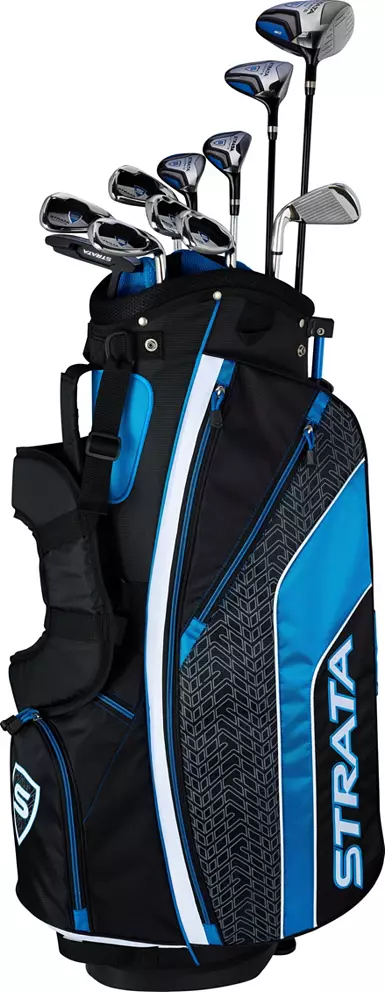
Callaway Strata
~$481 — the product we use and recommend for this topic.
🎯 Gear that helps with this
Every recommendation is independently purchased and tested over 40+ rounds.
Frequently Asked Questions
What clubs does a beginner actually need?
Start with 6 clubs: a driver, 5-hybrid, 7-iron, 9-iron, sand wedge, and putter. A complete starter set like the Callaway Strata (from ~$455) covers everything for your first 20 rounds. Add clubs as you identify distance gaps.
Should a beginner take lessons or learn from videos?
One lesson with a PGA pro is worth 20 hours of YouTube. A pro corrects your specific faults in real time. After that initial lesson, videos are great for reinforcement. Budget $75 to $100 for a single lesson — it is the best money you will spend in golf.
How long does it take to break 100?
Most beginners who practice twice a week and play once a week break 100 within 3 to 6 months. The fastest path is focusing on short game — putting and chipping — which accounts for 65 percent of your strokes but gets the least practice time.
How much does it cost to start playing golf?
Budget $350 to $500 to start: $300 for a starter club set, $30 for balls and tees, and $40 for a round at a public course. Used clubs from GlobalGolf or 2nd Swing can cut the initial investment in half.
Is golf hard to learn?
Golf is easy to start and hard to master. Most beginners can make solid contact and finish 18 holes within a few weeks. Breaking 100 takes months, breaking 90 takes a year or more of practice. The learning curve is part of what makes the game rewarding.
What should I wear to a golf course?
Collared shirt (polo), golf shorts or pants, and athletic shoes or golf shoes. Avoid jeans, tank tops, flip-flops, and gym shorts. Most public courses are relaxed about dress code, but a collared shirt is expected everywhere.
⚖️ Still deciding between two?
These head-to-head comparisons test the exact products from this guide side by side.
🏢 More for Cubicle Golfers
You work 9-to-5. Golf is your weekend reset. These guides are built for your schedule.
Last updated: 2026-04-28