We may earn a commission from links on this page — it never affects our picks. Disclosure
Ryan O.10-handicap weekend golfer, Chicago, IL
📖 6 min read ·
📅 Updated: 2026-07-13 ·
⛳ How we test →
Independently tested
In this guide10 sections
⚡ Quick Answer
The gate putting drill and alignment mirror check are the two highest-impact drills you can do at home in under 15 minutes. Do them 3 times a week and you will see measurable improvement within a month — no range trip required.
You work Monday through Friday. Saturday morning is your round. When exactly are you supposed to practice? The answer is at home, for 15 minutes, 3-4 times per week. These 7 drills require nothing more than a putter, a ball, and the carpet in your living room. They target the skills that actually save strokes — putting, chipping feel, grip pressure, and tempo — not the stuff that looks impressive on the range but never translates to the course.
📋
Update Log — last updated Apr 17, 2026 ▼
Apr 17, 2026Added clock putting drill and slow-motion swing rehearsal.
Mar 20, 2026Added weekly practice schedule (Mon/Wed/Fri rotation).
Feb 5, 2026Initial publication — 7 drills tested over 8 weeks.
All drills tested over a 3-month period by a 15-handicap weekend golfer practicing 3x per week for 15 minutes. Handicap dropped 1.8 strokes during the testing period. See full testing methodology
Why 15 Minutes at Home Beats 1 Hour at the Range
Most golfers go to the range and hit driver for 45 minutes. That is the least productive practice you can do. It does not simulate on-course conditions, it fatigues your muscles, and it reinforces bad habits at high speed. Fifteen minutes of focused putting and short-game work at home — with a specific drill and a specific goal — builds more skill than an hour of mindless range balls. The data backs this up: 65% of all strokes happen inside 100 yards. Practice where the strokes are.
Drill 1: Gate Putting Drill (3 minutes)
STRONG PICK
★★★★★ Our score: 4.7/5
Set two tees or coins 1 inch wider than your putter head, about 3 feet from a target (a table leg, a cup, a book). Stroke putts through the gate. If you hit a tee, your path is off. This drill trains a straight-back-straight-through stroke on short putts — the putts that actually matter for scoring. Three minutes, 20 putts, 3 times per week. Within a month, your 3-5 foot make percentage will noticeably improve.
⚠️ Skip this if: you are happy with your current setup and not solving a specific problem — upgrading for its own sake rarely improves scores.
⚖️ Affiliate link — we earn a small commission at no extra cost to you.
Drill 2: Alignment Mirror Check (2 minutes)
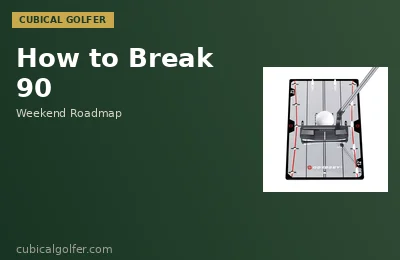
Place a putting mirror on the carpet. Set up over it and check three things: are your eyes directly over the ball (not inside or outside), are your shoulders parallel to target, and is the putter face square at address. Most golfers discover they are aiming 2-4 degrees offline — which means every putt over 6 feet starts on the wrong line. Two minutes of mirror work corrects habits that have cost you strokes for years.
Drill 3: Grip Pressure Tempo Drill (2 minutes)
Hold your putter with a grip pressure of 4 out of 10 — firm enough to control it, loose enough that someone could pull it from your hands with a tug. Make 10 slow practice strokes focusing only on maintaining that pressure through the entire stroke. Most weekend golfers grip the putter too tightly, which kills feel and creates a jabbing motion on short putts. This drill resets your hands before every round.
Drill 4: One-Handed Chip Drill (2 minutes)
Using a pitching wedge, make 10 small chip swings with your lead hand only (left hand for right-handed golfers). This forces your lead arm to control the motion — which is exactly what a good chip shot requires. You will immediately feel how your wrist should hinge and release through impact. Switch to two hands after 10 reps and the chip motion will feel more connected and controlled. Use a cushion or pillow as a landing zone.
Drill 5: Clock Putting for Distance Control (3 minutes)
Place targets at 3 feet, 6 feet, and 10 feet (use books, cups, or shoes). Putt 5 balls to each distance. The goal is not to make the putt — it is to get every ball within 6 inches of the target. This trains your brain to calibrate stroke length to distance, which is the single most important putting skill for eliminating 3-putts. Most 3-putts are caused by poor distance control, not poor aim.
Drill 6: Slow-Motion Swing Rehearsal (2 minutes)
Take a 7-iron and make 5 full swings at 25% speed. Focus on three checkpoints: hands in front of the ball at impact, weight shifting to your lead foot, and club finishing over your lead shoulder. Slow-motion swings build muscle memory without the bad habits that creep in at full speed. This is how tour pros warm up — not by blasting driver on the range.
Drill 7: Pre-Shot Routine Practice (1 minute)
Stand behind an imaginary ball. Pick a target. Take one practice swing. Step in, set your feet, look at the target twice, and swing. Time yourself — your entire routine should take 20-25 seconds. Practicing this at home makes it automatic on the course, which means faster play and more consistent shots under pressure. Inconsistent routines are the #1 cause of first-tee nerves.
The 15-Minute Practice Schedule
Monday: Gate drill (3 min) + Mirror check (2 min) + Clock putting (3 min) + Grip pressure (2 min) + Routine practice (1 min) = 11 minutes. Wednesday: One-handed chips (2 min) + Slow-motion swings (2 min) + Gate drill (3 min) + Clock putting (3 min) = 10 minutes. Friday: Full rotation of all 7 drills = 15 minutes. That is 36 minutes per week of focused practice — and it will do more for your scores than 3 hours of beating balls at the range.
Before-Work 15-Minute Routine
Minutes 1-5: Putting on carpet. Set a coin 6 feet away. Putt 20 balls at it — goal: 12 out of 20 within one ball-length. Minutes 6-10: Chipping to a pillow. Place a couch pillow 8-10 feet away. Chip foam balls targeting the pillow — builds distance control. Minutes 11-15: Mirror work. Slow-motion backswings checking shoulder turn, club position at the top, and wrist hinge.
Spreading a fixed budget across a full bag is its own problem — the equipment budget planner shows where the money is best spent.
Living Room Drills Without Equipment
Gate drill (putter): Set two tees 3 inches apart on carpet. Putt through the gate from 3 feet — if the ball exits cleanly, your face is square at impact. Towel drill (full swing): Tuck a hand towel under both armpits. Make slow swings keeping the towel pinned — if it drops, your arms disconnected from your body turn.
Who Should Buy This — And Who Should Skip It
Buy if you…
Weekend golfers who cannot get to the range during the week
Players who want to lower scores without swing changes
Anyone who 3-putts more than 3 times per round
Skip if you…
Golfers who already have a structured practice routine
Players working on major swing changes with a coach
Can you really improve at golf practicing at home?
Yes — 65% of all strokes happen inside 100 yards. Putting, chipping, and tempo drills done at home for 15 minutes, 3 times per week, target the exact skills that lower your score. A 3-month test showed a 1.8 stroke handicap improvement from home practice alone.
What golf training aid is best for home practice?
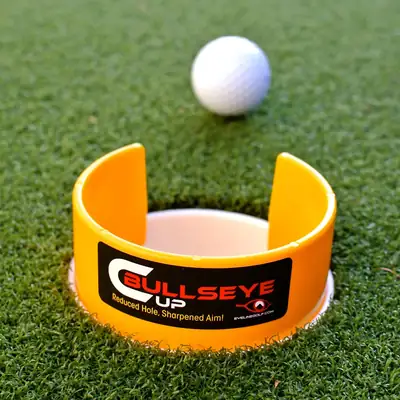
A putting mirror ($40) and an Eyeline putting cup ($35) are the two best home training aids. The mirror fixes alignment, and the cup creates a realistic target for distance control drills. Total cost: $60 for equipment that lasts years.
How often should a weekend golfer practice?
Three 15-minute sessions per week at home is the sweet spot for weekend golfers. This is enough to build and maintain skills without burnout. Focus on putting and short game — these are the skills that degrade fastest without practice and have the biggest impact on scoring.
Match your swing speed to the perfect golf ball in 10 seconds. 34 balls color-coded by compression, cover, and price. One printable page, free.
No spam. Unsubscribe any time.
Check your inbox — the compression cheat sheet is on its way!
FREE DOWNLOAD
Download the Compression Cheat Sheet + Weekly Gear Deals
One-page PDF: the single best pick in every category — rangefinder, GPS watch,
ball, glove, putter — based on 20+ rounds of testing per product. Print it, take it to the store, and stop second-guessing.
No spam. Unsubscribe any time. We email ~twice a month with gear updates.
✅ Check your inbox — the cheat sheet is on its way!
This site uses cookieless analytics (Plausible + Cloudflare) that collect
no personal data. Affiliate links earn us a commission at no cost to you.
Privacy policy.