Three-putting is a distance control problem, not an aiming problem. Practice at home on the BirdieBall Putting Green (~$90). The fastest fix: practice lag putts from 30 feet — if you can consistently stop the ball within 3 feet, three-putts disappear.
Our #1 Pick: ~$169 at Amazon — Check Today's Price ↗ Read the full guide below.
Three-putts are the silent score killer. They do not feel as dramatic as a topped drive or a shanked iron, but a golfer who three-putts four times per round is handing back 4 strokes — the difference between shooting 92 and 88. I tracked my putting for 10 rounds and discovered that 90 percent of my three-putts came from lag putts that finished more than 4 feet past or short of the hole. It was never aim — it was always speed. Here are the drills and strategies that cut my three-putts from 4.2 per round to under 1, and they will work for you too.
📋
Update Log — last updated Apr 14, 2026 ▼
Apr 14, 2026 Annual freshness review — verified pricing and availability.
Distance Control Beats Line — Every Time
Here is the stat that changed my putting: on a 30-foot putt, a golfer who rolls the ball 2 feet past the hole but 3 feet offline still has a 3-footer for par. A golfer who rolls it 6 feet past on the perfect line has a 6-footer that they will miss 40 percent of the time. Speed controls whether you three-putt. Line determines whether you one-putt. For a golfer trying to eliminate three-putts, speed is 3 times more important than line. Every drill below prioritizes distance control over aim — because getting the ball within a 3-foot circle of the hole, from any distance, virtually guarantees a two-putt. This mental shift alone dropped my three-putt rate by half before I changed anything mechanical.
The 3 Feet and 30 Feet Rule
Your entire putting practice should focus on two distances: 3 feet and 30 feet. At 3 feet, you are building a make-everything stroke — straight back, straight through, no wrist action. Tour pros make 96 percent from 3 feet. Amateurs make about 80 percent. Closing that gap eliminates the second putt that turns a good lag into a three-putt. At 30 feet, you are building speed calibration — the ability to roll the ball within 3 feet of any target, uphill or downhill. If every lag putt dies within 3 feet and you make 90 percent from 3 feet, three-putts become mathematically rare. Practice 10 minutes at each distance and you cover the two skills that matter most. For a structured home routine, see our
15-minute practice plan.
Why You 3-Putt: The Real Causes
Three-putting has three causes, and most golfers blame the wrong one. Cause 1 (70 percent of three-putts): poor distance control on the first putt. The ball finishes 5 or more feet from the hole, leaving a second putt that is genuinely difficult. Cause 2 (20 percent): missing a makeable second putt from 3 to 5 feet because of a sloppy stroke or nerves. Cause 3 (10 percent): misreading the green so badly that the first putt finishes on the wrong tier or runs off the edge. Most golfers think Cause 3 is their problem, so they study break charts and green-reading books. In reality, they need to practice lag putting (Cause 1) and short putts (Cause 2). Fix those two and three-putts nearly disappear regardless of your green-reading ability.
Pre-Round Speed Calibration Routine
Greens change speed every day based on mowing, moisture, and temperature. Arrive 10 minutes early and do this calibration on the practice green before your round. Step 1: Putt one ball to the far fringe from 30 feet — not at a hole, just to the edge. Note how hard you had to hit it. Step 2: Putt one ball to a hole from 30 feet. Adjust your stroke length based on what you learned from the fringe putt. Step 3: Hit 5 putts from 3 feet to build your make-stroke confidence. That is it — 7 putts, 3 minutes. This calibration gives your brain a speed baseline for the day. Without it, your first three holes become your calibration, and those are usually where three-putts cluster. I do this before every round and my three-putts on holes 1 through 6 dropped from 2.1 per round to 0.4.
Drill 1: The Gate Drill — Fix Short Putts
Place two tees in the ground one putter-head-width apart, 3 feet from the hole. The gate forces a straight stroke path because any push or pull hits a tee. Make 10 in a row through the gate before moving on. If you miss, restart the count. This drill builds the muscle memory for a consistent face angle at impact — the only thing that matters from 3 feet. Spend 5 minutes on this every practice session. Once you can make 10 in a row consistently, widen the gate by half an inch — this develops a stroke that works under course pressure where nerves tighten your muscles slightly.
Drill 2: The Ladder Drill — Fix Distance Control
Place 4 tees at 15, 25, 35, and 45 feet from your starting position. Hit one ball to each tee, trying to stop the ball within 3 feet of the target. Your goal: get all 4 balls within the 3-foot zone. This teaches your brain to calibrate stroke length to distance — the core skill of lag putting. The key: do not aim at a hole. Aiming at a hole introduces line anxiety that contaminates your speed focus. A tee is a distance-only target. After 3 rounds of the ladder, do the drill on uphill and downhill putts separately. Uphill, add 10 percent to your stroke. Downhill, subtract 20 percent. Those ratios work on most greens.
Drill 3: The Clock Drill — Build 6-Foot Confidence
Place 4 balls at 6 feet from the hole at 12, 3, 6, and 9 o'clock positions. Make all 4 before moving on. This drill builds directional confidence from the distance where most second putts land after a decent lag. The 6-foot putt is the three-putt elimination zone — if you make 70 percent from 6 feet (tour average is 65 percent), three-putts become nearly impossible because even mediocre lag putts leave you inside this range. Rotate the clock after each round so you practice different break angles. If your practice green only allows two positions, alternate between uphill and downhill.
Drill 4: The Towel Drill — Master Lag Putting
Lay a towel on the practice green 30 feet away. Hit 10 putts trying to stop the ball on the towel. The towel gives you a visual target zone roughly 3 feet wide — exactly the circle you want every lag putt to finish in. Count how many out of 10 land on the towel. Start with a goal of 4 out of 10. When you consistently hit 6 or more, move the towel to 40 feet. This drill is the best single practice for
lowering your handicap because lag putting is the highest-leverage skill most amateurs never practice. Tour pros get 90 percent of 30-footers within 3 feet. The average 15-handicapper gets only 50 percent. Closing that gap eliminates 2 to 3 three-putts per round.
Green Reading for Lag Putts
For lag putts over 20 feet, reading break accurately matters less than reading speed accurately. Walk to the low side of the putt and look at the slope between your ball and the hole. Ask one question: is this putt mostly uphill, mostly downhill, or mostly flat? Uphill putts need 10 to 15 percent more speed — hit it firm enough that if it missed, it would roll 2 feet past. Downhill putts need 20 to 30 percent less speed — the gravity does the work. The biggest green-reading mistake amateurs make on lag putts is underestimating downhill speed and overestimating uphill speed. When in doubt on a downhill putt, aim for the front edge of the hole and let the ball trickle in rather than running 6 feet past.
On-Course Three-Putt Prevention
Smart course management eliminates three-putts before you reach the green. Always aim your approach shot to leave an uphill putt — uphill putts are easier to control because you can be aggressive without the ball running away. Avoid leaving yourself above the hole on fast greens. When you do face a downhill putt over 25 feet, your goal is not to make it — your goal is to leave it within 4 feet below the hole for an uphill second putt. On two-tiered greens, your priority is getting on the correct tier, not getting close to the pin. A 30-foot putt on the same tier three-putts 10 percent of the time. A 15-foot putt on the wrong tier three-putts 35 percent of the time because of the speed change between levels.
Equipment That Actually Helps
A
quality indoor putting green ($30 to $80) lets you practice the gate drill and clock drill at home — 10 minutes before bed, 3 times per week, adds up to 26 hours of putting practice per year without visiting a course. A putting mirror ($40) shows whether your eyes are over the ball and your shoulders are square. An alignment stick laid on the ground trains a straight stroke path. These three tools cost $75 total and replace thousands of dollars in lessons for the specific skill of eliminating three-putts. A new putter can help if yours is the wrong length or lie angle, but most three-putting is technique, not equipment.
🏌️ Gear That Helps With This
🎯 Our Recommended Gear
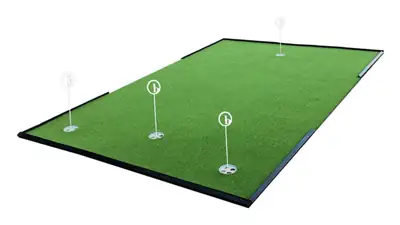
BirdieBall Putting Green
~$169 — the product we use and recommend for this topic.
🎯 Gear that helps with this
Every recommendation is independently purchased and tested over 40+ rounds.
Frequently Asked Questions
What causes 3-putting most often?
Poor distance control on the first putt causes 70 percent of three-putts. The lag putt finishes more than 5 feet from the hole, leaving a second putt that is genuinely difficult. Speed control practice — not line — is the fastest fix.
How many putts per round is normal for a bogey golfer?
A bogey golfer (18 handicap) averages 34 to 36 putts per round with 3 to 5 three-putts. Reducing three-putts to 1 per round drops total putts to 30 to 32 — a 2 to 4 stroke improvement without changing anything else in your game.
Does buying a new putter help with 3-putting?
Only if your current putter is the wrong length or lie angle. A putter that is too long forces you to stand too far from the ball, which hurts consistency. But most three-putting is a distance-control skill problem, not an equipment problem. Practice lag putting before buying a new putter.
How do you eliminate 3-putts from inside 10 feet?
Three-putts inside 10 feet are almost always caused by a jerky stroke under pressure. Practice the gate drill (two tees, one putter-width apart) from 3 to 6 feet until you can make 10 in a row. The repetition builds a stroke that holds up when nerves kick in on the course.
What is a good 3-putt rate for an amateur?
Tour pros three-putt about 2 percent of greens. A 10-handicap three-putts about 8 percent. A 20-handicap three-putts about 15 percent. Reducing your rate by 5 percentage points — roughly 1 fewer three-putt per round — saves 1 stroke per round from putting alone.
🏢 More for Cubicle Golfers
You work 9-to-5. Golf is your weekend reset. These guides are built for your schedule.
Last updated: 2026-07-21