Fat iron shots happen when the club hits the ground before the ball. The #1 cause: weight staying on your back foot through impact. The fix: feel 80% of your weight on your lead foot at impact. Our top pick: the Fiberbuilt Studio Mat (~$499).
Our #1 Pick: ~$499 at PlayBetter — Check Today's Price ↗ Read the full guide below.
Fat iron shots are caused by one of three things: ball position too far forward, weight staying on the back foot, or early release of the wrists. The fastest fix for most golfers is moving the ball one ball-width back in the stance and focusing on finishing with 80 percent of weight on the front foot. This alone eliminates 70 percent of fat shots without changing your swing mechanics.
A fat iron shot — where the club hits the ground before the ball — is one of the most common mistakes for recreational golfers. Unlike a topped shot, a fat hit loses both distance and direction simultaneously. Here are the four causes, in order of frequency.
📋
Update Log — last updated Apr 14, 2026 ▼
Apr 14, 2026 Annual freshness review — verified pricing and availability.
The Real Root Cause: Low-Point Control
Every fat shot has one underlying cause: the lowest point of your swing arc is behind the ball instead of in front of it. When the club bottoms out too early, it digs into the turf before reaching the ball. With a properly struck iron, the club should hit the ball first and then the ground — your divot starts where the ball was and extends forward by 2 to 4 inches. If your divots start behind the ball, your low point is wrong. Everything below is a different way your swing moves the low point backward. Fix any one of them and you will start taking divots in front of the ball.
Cause 1: Weight Staying on the Back Foot
This is the most common cause of fat shots for golfers above a 15 handicap. During the downswing, your weight should shift to your lead foot so that at impact, about 70 to 80 percent of your weight is forward. When your weight hangs back on the trail foot, the lowest point of your swing arc stays behind the ball. The feel you want: your lead hip should be over your lead ankle at impact. A good checkpoint is to hold your finish position — if you could not lift your trail foot off the ground without falling over, your weight did not transfer far enough.
Cause 2: The Helping-the-Ball-Up Instinct
Your brain sees the ball on the ground and instinctively wants to scoop it into the air. So you flip your wrists, hang back, and try to slide the club under the ball — all of which guarantee fat contact. The truth: a 7-iron has 33 degrees of loft built into the face. Hit down on the ball and the loft launches it high. You do not need to help. The mental key is trusting that hitting down produces shots that go up. It feels counterintuitive for the first 50 swings, and then it clicks. A helpful mantra: compress the ball into the turf, do not lift it off the turf. The same instinct causes
topped shots — when the scoop attempt goes slightly wrong, the leading edge catches the equator instead of the ground.
Cause 3: Swaying Instead of Rotating
A lateral sway — sliding your hips toward the target instead of rotating them — shifts the entire swing arc forward on the backswing and backward on the downswing, making low-point control nearly impossible. In a good swing, your head stays roughly centered while your hips and shoulders rotate around your spine. In a sway, your head moves 3 to 4 inches toward the target on the backswing and then 3 to 4 inches away on the downswing. That return trip rarely brings you back to the exact starting position, so your low point wanders. The fix: place an alignment stick vertically in the ground just outside your trail hip at address. If your hip pushes the stick during the backswing, you are swaying. Keep your trail hip rotating, not sliding.
Cause 4: Ball Position Too Far Forward
If the ball is ahead of center in your stance, your club reaches its lowest point before the ball and starts climbing upward at contact — catching the ground on the way down and the ball on the way up (fat then thin). For most irons, the ball should be in the center of your stance. For longer irons and hybrids, one ball-width forward of center. For wedges, center or slightly back. A quick check: set up with your 7-iron and let a ball drop from the bridge of your nose. Where it lands is where your ball should be. Correcting ball position is the fastest fat-shot fix because it requires zero swing changes — just move the ball back.
Why Range Mats Hide Your Fat Shots
This is why you hit beautifully on the range and terribly on the course. Range mats are forgiving: when you hit 2 inches behind the ball on a mat, the club bounces off the hard surface and still makes decent contact with the ball. The shot feels fine and flies reasonably well. On real grass, that same 2 inches behind the ball digs into the turf, the club decelerates, and you get a fat chunk that travels 40 yards. The mat was masking your fat contact the entire time. The fix: whenever possible, practice on grass — even if it means hitting off the grass strip at the edge of the range. If you can only practice on mats, place a thin line of baby powder or foot spray 1 inch behind the ball. If your club hits the powder, you are hitting fat even though the mat forgives it.
Fat and Thin Are the Same Problem
This surprises most golfers: fat shots and thin shots (skulled, bladed, topped) share the same root cause — poor low-point control. When the low point is behind the ball, the club hits the ground first (fat). If the club bounces off the ground and catches the ball on the way up, you get a thin or topped shot. They are two symptoms of the same disease. So if you alternate between fat and thin during a round, do not try to fix two things. You have one problem: your low point needs to move forward. The drills below fix both simultaneously because they train the club to reach its lowest point in front of the ball, not behind it. For the thin/topped side specifically, our
topping guide covers additional drills.
Drill 1: The Tee-in-the-Ground Drill
Push a tee into the ground 2 inches in front of the ball so just the top of the tee is visible. Hit shots trying to clip the tee after striking the ball. If you hit the ball but miss the tee, your low point is behind the ball — even if the shot felt decent on a mat. When you start clipping the tee, your divots are starting in the right place and your contact becomes clean and crisp. Start with half swings using a 9-iron, then build to full swings. This is the single best low-point drill because the feedback is immediate and unambiguous.
Drill 2: The Step-Through Weight Transfer Drill
Set up normally with a 7-iron. On the downswing, step your trail foot forward past the ball as you swing through — like you are walking toward the target. This forces your weight onto your lead foot and physically prevents the hang-back position that causes fat shots. Hit 20 balls this way. The step-through feels absurd but it teaches your body what a proper weight shift feels like. After 20 step-through swings, hit 10 normal swings. You will feel the forward shift carrying over into your regular swing. This drill also works at home with
foam practice balls — no range needed.
The Quick On-Course Fix Mid-Round
If fat shots start appearing during a round and you cannot stop to drill, use this emergency adjustment: move the ball one ball-width back in your stance and feel like you are pressing your hands slightly forward at address. This shifts your low point forward by 1 to 2 inches — enough to turn a fat shot into ball-first contact. It is not a permanent fix (your distance will be slightly shorter with the ball back), but it prevents the bleeding. Also check your grip pressure: tension above a 5 out of 10 tightens your forearms and restricts the natural wrist release, which moves the low point backward. Lighten up and take one smooth practice swing focusing on brushing the grass at the point where your ball would be.
🏌️ Gear That Helps With This
🎯 Our Recommended Gear
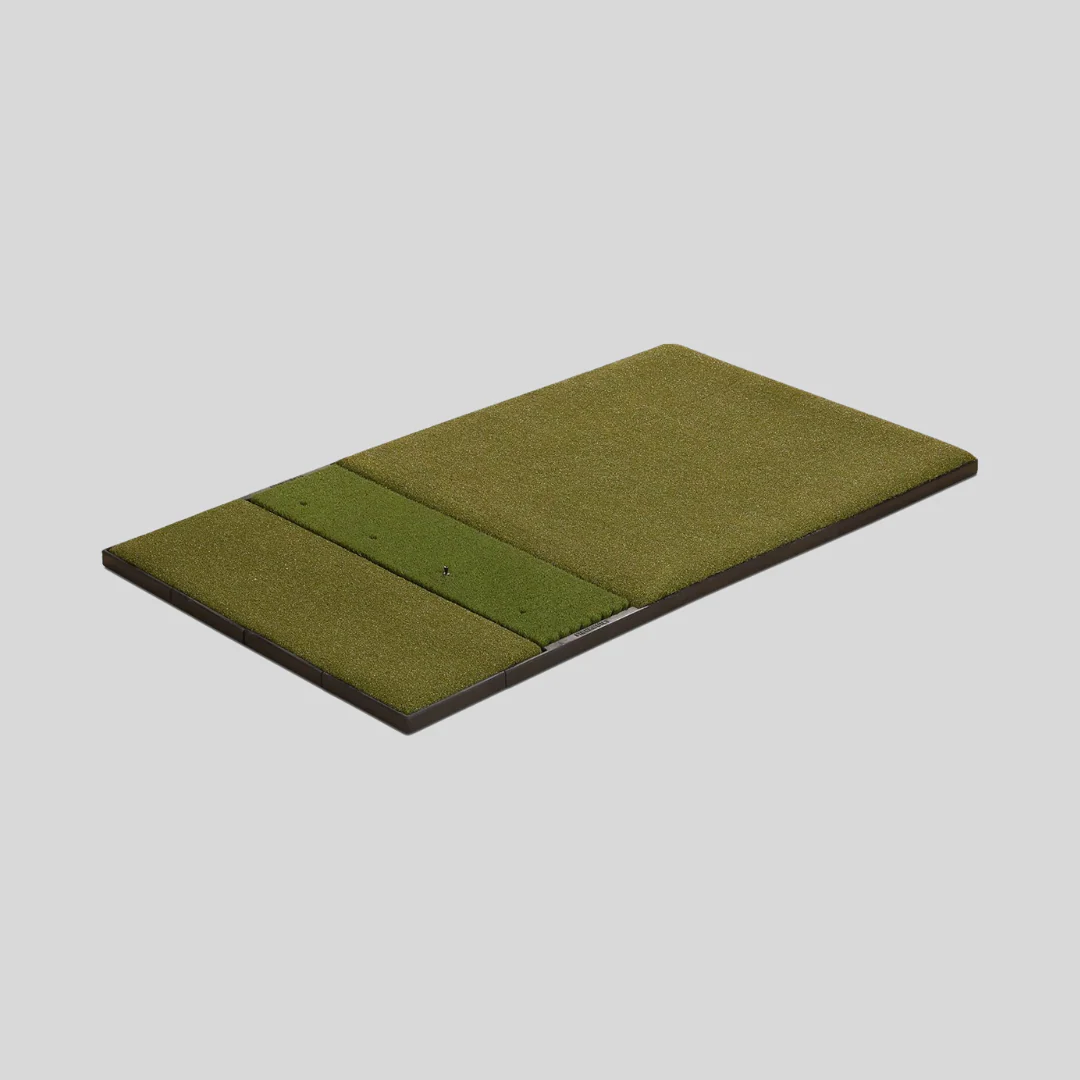
Fiberbuilt Studio Mat
~$499 — the product we use and recommend for this topic.
🎯 Gear that helps with this
Every recommendation is independently purchased and tested over 40+ rounds.
Frequently Asked Questions
Is it better to hit the ball fat or thin?
Thin is better. A thin shot still travels most of the intended distance, just lower than normal. A fat shot loses 30 to 60 percent of its distance and often does not reach the green. If you have to miss, miss thin — it is a more playable result.
Why do I hit fat shots only when I am nervous?
Nerves cause tension in your forearms and grip, which restricts wrist release and slows the club down before impact. The club reaches the ground early. The fix: make a conscious effort to lighten your grip to a 4 out of 10 on nervous shots. Soft hands release naturally.
Does a wider sole help prevent fat shots?
Yes. Game-improvement irons and hybrids with wider soles bounce through the turf instead of digging on fat contact. The wider sole does not fix the root cause, but it reduces the penalty. If you hit fat frequently, cavity-back irons with wide soles are significantly more forgiving than blades.
Why do I hit well on range mats but fat on the course?
Range mats are hard and bounce the club into the ball even when you hit 2 inches behind it. Real grass does not forgive. The mat masks your fat contact. Practice on grass whenever possible, or use a powder line behind the ball on mats to reveal hidden fat strikes.
Can fat shots damage my wrists?
Repeatedly hitting fat shots on firm turf can cause wrist and elbow strain because the sudden deceleration transfers force into your joints. If you hit fat frequently, use a quality hitting mat with some give, and fix the root cause — do not just absorb the impact round after round.
⚖️ Still deciding between two?
These head-to-head comparisons test the exact products from this guide side by side.
🏢 More for Cubicle Golfers
You work 9-to-5. Golf is your weekend reset. These guides are built for your schedule.
Last updated: 2026-09-12