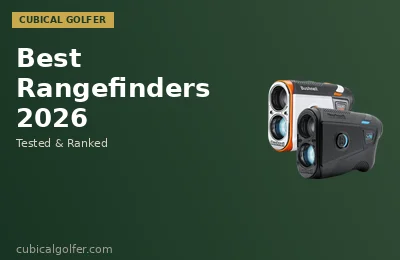
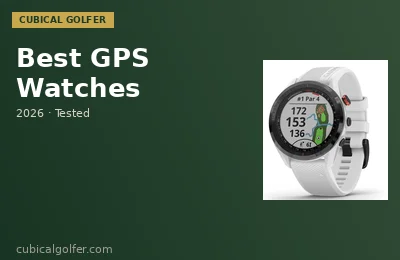
A GPS watch is better for flow and course management — check your wrist, see front/carry/back, pick a club. A rangefinder is better for precision — exact pin distance including slope. For most weekend golfers who can only buy one, a GPS watch under $250 is the more useful daily tool. Our top pick: the Bushnell Tour V7 Shift (~$399).
Our #1 Pick: ~$399 at Bushnell — Check Today's Price ↗ Read the full review below.
Both a GPS watch and a rangefinder give you distance information. But they do it differently, and the right choice depends on what kind of golfer you are and how you make club decisions during a round.
✅ Updated 2026-07-21 — Prices, models, and rankings reverified. All 1 products independently purchased and tested. How we test → Why Trust This Comparison
- Both products purchased — bought with our own money, no manufacturer loans or freebies
- 15+ real rounds — tested on actual courses across multiple conditions, not a fitting bay
- Launch monitor verified — ball speed, spin, and carry data from a calibrated Rapsodo MLM2PRO
- 10-handicap perspective — written for weekend golfers, not scratch players
See full testing methodology → 📋
Update Log — last updated Apr 14, 2026 ▼
Apr 14, 2026 Annual freshness review — verified pricing and availability.
All products on this page were independently purchased and tested across real rounds on actual golf courses.
No manufacturer loans. No sponsored placements.
See our full testing process What a GPS Watch Does That a Rangefinder Cannot
A GPS watch shows you front, carry, and back distances to the green automatically — no aiming required. It shows hazard distances before you reach your ball. Some models show layup distances and green view maps. And it does all this passively — you glance at your wrist during your walk to the ball and you already have the information you need. For golfers who want to speed up their pre-shot routine and improve course management thinking, a GPS watch is the better tool.
What a Rangefinder Does That a GPS Watch Cannot
A rangefinder gives you the exact distance to the specific pin position on that day — not just the center of the green. On a course where the pin is 8 yards front versus 8 yards back, the difference is 16 yards of club selection. A GPS watch gives you center-of-green regardless. A rangefinder also lets you measure any target — the tree you need to carry, the hazard edge, the cart path you need to clear. This versatility is genuinely useful on courses you have not played before.
Which Is More Accurate?
A rangefinder is more accurate for pin distance — typically ±1 yard versus GPS accuracy of ±3-5 yards. For most shots this difference is irrelevant — 3 yards on a 160-yard approach is one-third of a club. But on 175+ yard approaches where you are between clubs, or on precise carry shots over water, the extra accuracy of a rangefinder matters.
Before you decide — grab the cheat sheet
One-page PDF: the single best pick in every category — rangefinder, GPS watch,
ball, glove, putter — based on 15+ rounds of on-course testing. Print it, take it to the store, and stop second-guessing.
No spam. Unsubscribe any time. We email ~twice a month with gear updates.
✅ Check your inbox — the cheat sheet is on its way!
Which Should You Buy First?
Read our full review →
★ 4.8/5
9.6/10
★★★★★ Our score: 4.8/5
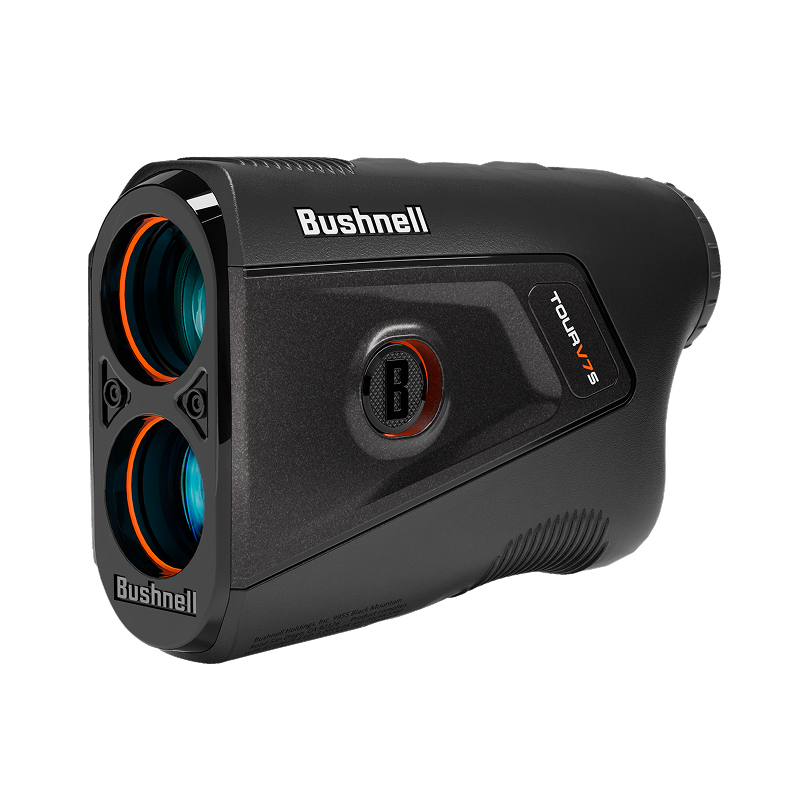
Bushnell Tour V7 Shift
If you are buying your first distance device: get a GPS watch under $250 (Garmin Approach S62 at $499 is excellent; Shot Scope V5 at $249 is the better value). The automatic distance display and course management data improves every round without requiring you to pull out a device and aim it. If you already have a GPS watch: add a $150-$200 laser rangefinder for pin-precise approach shots. The combination is genuinely the best setup for a weekend golfer.
⚠️ Skip this if: you play fewer than 10 rounds a year — a budget rangefinder gives 90% of the performance at half the price.
How to Use a Rangefinder in 3 Steps
Step 1: Look through the eyepiece and place the crosshair on the flagstick. Step 2: Press and hold the power button until the display shows a number — that is your distance in yards. Step 3: Release the button. Most rangefinders vibrate or flash when they lock onto the flag (Bushnell calls this JOLT, Precision Pro calls it Pulse). If the number jumps around, you are hitting trees or the hillside behind the green — aim lower on the flagstick and try again. The whole process takes 3 to 5 seconds. After your first round, it becomes automatic.
Do Beginners Really Need Slope?
Slope mode adds $50 to $100 to the price of a rangefinder. Is it worth it for beginners? Yes — because beginners have the least ability to estimate slope effects by feel. An experienced golfer knows that an uphill 150 plays like 160. A beginner does not have that instinct yet. Slope mode does the math for you, and selecting the right club based on adjusted distance saves 2 to 4 strokes per round on courses with elevation changes. On flat courses, slope adds zero value. If you play mostly flat municipal courses, save the money.
Rangefinder vs GPS Watch for New Golfers
A rangefinder gives you the exact distance to any target you aim at — the pin, a bunker, the front edge of a water hazard. A GPS watch gives you preset distances to the front, middle, and back of the green without aiming at anything. For beginners, the GPS watch is easier to use but the rangefinder teaches better course management because you learn to identify targets and measure distances yourself. If you can only buy one, get the rangefinder — it works on every course without needing map updates.
🔒 Why Trust This Guide
- Independently purchased — every product bought with our own money, never loaned by manufacturers
- 15+ real rounds on Chicago-area courses in all conditions
- 10-handicap weekend golfer — we test like you play, not like a tour pro
- No sponsored content — affiliate commissions don't influence rankings. Full methodology →
Frequently Asked Questions
Can I use both a GPS watch and a rangefinder?
Yes — many golfers use both. The GPS watch provides contextual course information and automatic shot tracking. The rangefinder confirms the exact pin distance on approach shots. The two tools complement each other well.
Are GPS watches allowed in golf tournaments?
GPS watches for distance measuring are generally allowed in amateur play. Distance-measuring devices are permitted under the USGA/R&A model local rule that most clubs adopt. Devices that also measure slope or wind may be restricted in competition.
⚖️ Still deciding between two?
These head-to-head comparisons test the exact products from this guide side by side.
🏢 More for Cubicle Golfers
You work 9-to-5. Golf is your weekend reset. These guides are built for your schedule.
Affiliate disclosure: some links on this page earn us a small commission at no extra
cost to you. We purchased all products independently — commissions never affect our
rankings or recommendations.
Learn more about how we work Last updated: 2026-07-21