Yes, slope is worth having — our top pick is the Bushnell Tour V7 Shift (~$399). It adjusts distance for elevation and helps with club selection on hilly courses. For tournament play, buy a model with a slope toggle so you can switch it off.
Our #1 Pick: ~$399 at Bushnell — Check Today's Price ↗ Read the full review below.
Yes, you need slope on your rangefinder if your course has any elevation changes over 20 feet. Slope adjusts the displayed distance for uphill and downhill shots — a 150-yard approach that is 25 feet uphill plays like 157 yards. Without slope, you club short on every uphill shot and long on every downhill. The feature saves 2 to 4 strokes per round on hilly courses and costs only $30 to $50 more than non-slope models.
Slope mode on a rangefinder tells you the adjusted carry distance after accounting for elevation change. A 150-yard uphill shot might play like 162 yards — slope tells you this without guessing. But does every golfer need it? No. Here is the honest breakdown.
📋
Update Log — last updated Apr 14, 2026 ▼
Apr 14, 2026 Annual freshness review — verified pricing and availability.
Slope in One Sentence
For the full explanation and a lookup chart covering every yardage and elevation, see what slope on a rangefinder actually means.
Slope measures the elevation difference between you and the flag using an inclinometer inside the rangefinder. It calculates the Plays Like distance — the flat-ground equivalent yardage. A 150-yard shot that plays 10 feet uphill might show 163 yards on a slope-adjusted rangefinder. A downhill shot of the same distance might show 138 yards. Without slope, you have to estimate this adjustment by feel or experience.
Who Genuinely Benefits from Slope
Slope delivers the most value on hilly courses (mountain resorts, courses with significant elevation change per hole), for golfers who play new courses frequently and have no feel for the terrain, and for anyone who consistently under- or over-clubs on approach shots. If you play the same 2 courses every week and have played them for years, you likely already have the elevation adjustments memorized. Slope is for unknowns.
Who Should Skip Slope
Golfers who play flat courses (most Florida, Texas, and Midwest courses have minimal elevation change) get little benefit. Golfers on a tight budget are better served buying a non-slope rangefinder for $129 and spending the savings on lessons or range time. Golfers who play in tournaments frequently need slope-off capability anyway — so they spend the whole round in flat mode.
Tournament Legality
USGA Rule 4.3 allows distance measuring devices but prohibits slope-adjusted distances during competition unless the Committee adds a Local Rule permitting them. Most club competitions do not permit slope. Any rangefinder with slope must have a clear slope-off toggle to be used legally. The Bushnell Tour V7 Shift has a physical switch — the gold standard for tournament play.
Our Recommendation
Read our full review →
★★★★★ Our score: 4.8/5
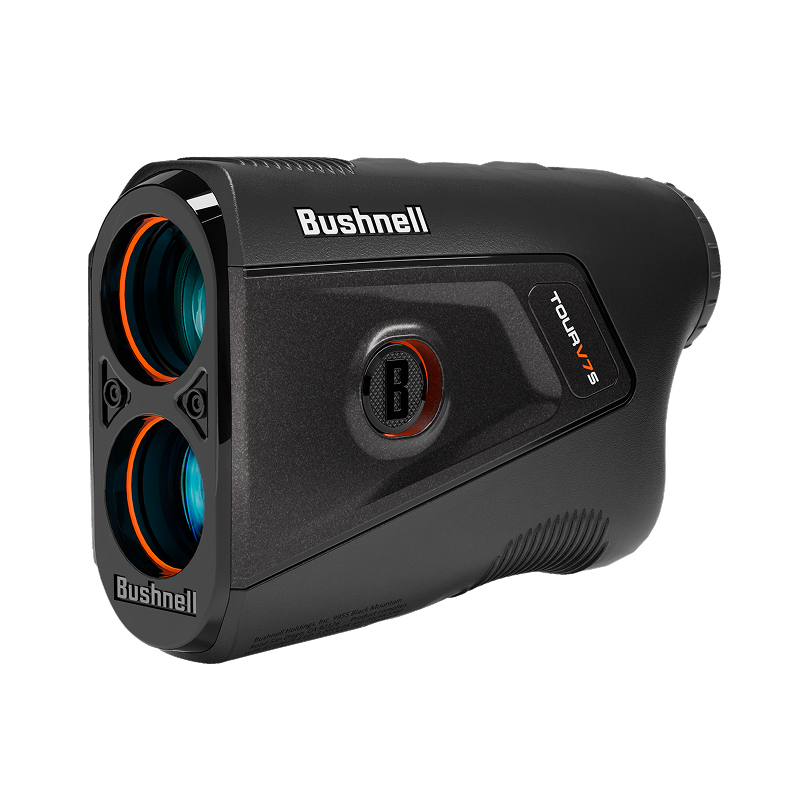
Bushnell Tour V7 Shift
If your budget is under $200, buy without slope. The Precision Pro NX9 gives accurate flat distances with a lifetime warranty. If your budget is $250+, buy with slope — the Bushnell Tour V7 Shift is the best choice because the SLOPE SWITCH is a physical toggle, not a menu setting. You can disable slope in 2 seconds before any competitive round.
⚠️ Skip this if: you play fewer than 10 rounds a year — a budget rangefinder gives 90% of the performance at half the price.
The Math: How Much Slope Saves You
On a course with 80 feet of total elevation change (typical of most non-flat courses), slope mode adjusts your yardage on 8 to 10 approach shots per round by 3 to 8 yards each. Clubbing correctly on those 8 shots saves an average of 3 strokes per round versus guessing. Over a season of 20 rounds, slope mode saves approximately 60 strokes. At a $30 to $50 price premium over non-slope models, slope pays for itself in less than one round of improved scoring.
When Slope Does Not Help
On dead-flat courses (many Florida and coastal courses), slope mode adds zero value — every adjustment reads zero. If you exclusively play flat courses, save the $30 to $50 and buy a non-slope model. Also, slope is not allowed in USGA-sanctioned competition (though every slope rangefinder has a tournament mode that disables it). If you play in competitive events regularly, you will need to switch it off. For the 95 percent of golfers who play casual weekend rounds on courses with any terrain variation, slope is worth the small premium.
🏌️ Gear That Helps With This
🎯 Our Recommended Gear
Bushnell Tour V7 Shift
~$399 — the product we use and recommend for this topic.
🎯 Gear that helps with this
Every recommendation is independently purchased and tested over 40+ rounds.
Frequently Asked Questions
Does slope make a difference for average golfers?
Yes on hilly courses — slope adjustments of 10-20 yards are common on elevation changes of 20+ feet. On flat courses, the difference is minimal (1-3 yards) and not worth paying a premium for.
Can you use a slope rangefinder in a golf tournament?
Yes, but only with slope mode turned OFF. Most modern slope rangefinders have a tournament mode or physical toggle. USGA Rule 4.3 allows distance-measuring devices but prohibits slope-adjusted readings during competition unless the Committee adds a Local Rule permitting them.
Which rangefinder has the best slope toggle?
The Bushnell Tour V7 Shift has a physical SLOPE SWITCH on the side of the unit — the easiest and most reliable slope toggle available. You can switch between slope and flat mode without opening any menus, which is critical when you forget to disable slope before a competitive round.
⚖️ Still deciding between two?
These head-to-head comparisons test the exact products from this guide side by side.
🏢 More for Cubicle Golfers
You work 9-to-5. Golf is your weekend reset. These guides are built for your schedule.
Last updated: 2026-07-21