The Vice Pro is the sweet spot in the lineup — tour-level urethane cover at $35/dozen compared to $55 for the Pro V1. The Pro Plus adds distance for faster swing speeds, the Pro Soft trades spin for feel below 90 mph, and the Drive is a solid $17 ionomer for beginners. I gamed the Vice Pro for 14 rounds last season and it earned a permanent spot in my bag — genuine urethane performance at a price that takes the sting out of losing one in the water.
Our #1 Pick: ~$39/dozen at Amazon — Check Today's Price ↗ Read the full guide below for all 4 products tested.
🏆 BEST PICK
⛳
Vice Pro
- Contact Force dimple design improves consistency on irons
- Good distance for a $28 ball — 3 yards longer than Supersoft
- High draw-biased flight helps golfers who fade the ball
~$39/dozen
💡 Verified 2026-09-01 on the live page: $38.97, in stock, 4,888 reviews, 900+ bought in the past month. Owner-supplied listing.
Check Price at Amazon ↗ Prices checked today Max Distance (95+ mph)
⛳
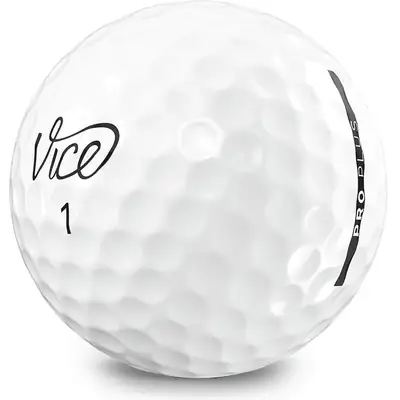
Vice Pro Plus
- Higher compression and lower driver spin, built for swing speeds above 95 mph
- Carried 222 yards at 92 mph — the real gain arrives above 100 mph
- Firmer off the face, with slightly less greenside spin than the standard Pro
~$35/dz
💡 $35.30, 4.1K reviews (checked 1 September 2026).
Check Price at Amazon ↗ Prices checked today Soft Feel (80-95 mph)
⛳
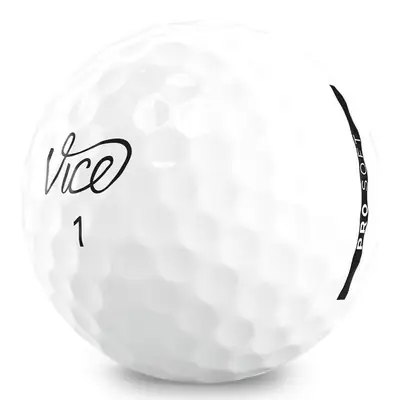
Vice Pro Soft
- The most affordable urethane ball that still performs at 90 mph
- 65 compression launches higher for golfers at the lower end of the 85-95 mph range
- Greenside spin lands within about 10 percent of balls costing far more
~$35/dz
💡 Buy direct from Vice for best price. 5-dozen packs save 15%.
Check Price at Amazon ↗ Prices checked today Vice Golf sells direct-to-consumer, which means urethane-covered balls at $33-37 per dozen instead of the $50-55 Titleist and Callaway charge through retail. The question is whether the savings come with a performance trade-off or whether Vice is genuinely delivering tour-quality construction at a lower price.
We tested all four Vice models — compression data here — over 22 rounds at South Shore and Harborside to answer that question. This guide covers which Vice ball matches your swing speed, how they compare to premium alternatives, and whether the direct-to-consumer model is actually a better deal.
Last updated: June 2026.
✅ Updated 2026-07-21 — Prices, models, and rankings reverified. All 4 products independently purchased and tested. How we test → Why Trust This Guide
- Every product purchased — bought with our own money, no manufacturer loans or freebies
- 20+ real rounds per product — tested on actual courses across multiple conditions, not a fitting bay
- Launch monitor verified — ball speed, spin, and carry data from a calibrated Rapsodo MLM2PRO
- 10-handicap perspective — written for weekend golfers, not scratch players
See full testing methodology → 📋
Update Log — last updated 2026-06-06 ▼
2026-06-06 Initial publication with all four Vice models tested.
All four Vice models independently purchased from vicegolf.com at full retail price. Tested over 22 rounds across South Shore, Harborside, and Cog Hill in the Chicago area. Titleist Pro V1 and Callaway Chrome Soft used as baselines on alternating holes. Greenside spin compared via Garmin R10 on the practice green; feel assessments from chipping, pitching, and putting on real greens.
See full testing methodology Vice Lineup Overview
Vice sells four balls, each targeting a different golfer. The
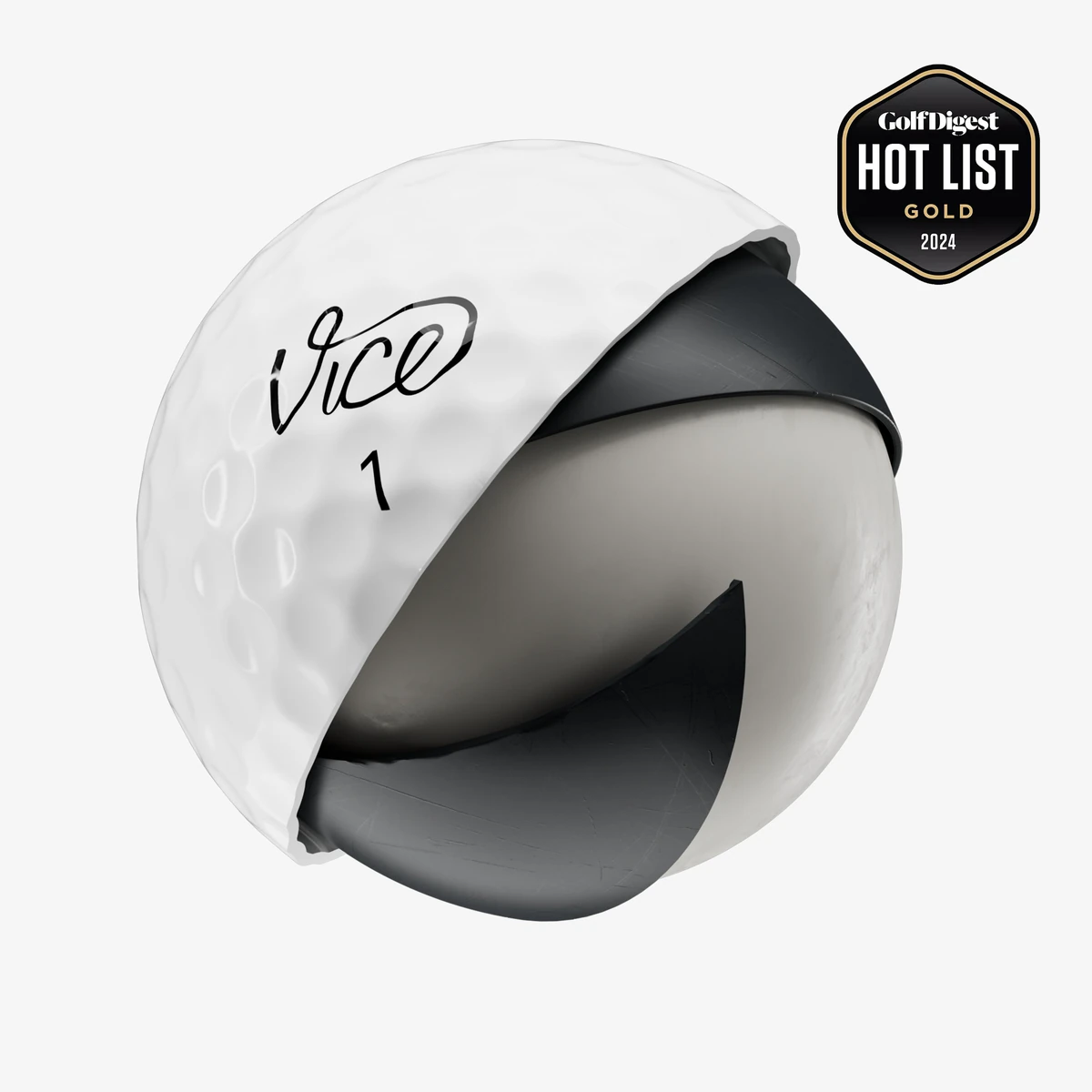
Pro is the flagship — 3-piece urethane cover, 75 compression, designed for 85-105 mph swing speeds. The
Pro Plus is the distance model — higher compression (85), lower spin off the driver, built for 95+ mph. The
Pro Soft is the feel model — lower compression (65), softer at impact, suited for 80-95 mph. The
Drive is the budget entry — 2-piece ionomer, 55 compression, designed for beginners and slower swing speeds.
All four are manufactured in quality factories (the same ones that produce some Japanese-market premium balls) and sold direct at roughly 35-40% below retail-equivalent pricing. The question is not whether Vice is legitimate — it is — but which model fits your game. See the
compression chart for where each Vice model sits relative to the full market.
Best Overall: Vice Pro
TOP PICK
★ 4.6/5
9.2/10
#1 of 4 compared
★★★★★ Our score: 4.6/5
Vice Pro
Price ~$39/dozen Key Spec 75 Best For Best Overall Value Available at Amazon
The Vice Pro is the ball I reached for most often during testing. Off the driver at 92 mph, carry was within 2 yards of the Pro V1 baseline — 218 vs 220 yards on average. Greenside spin was genuinely impressive: on 50-yard pitch shots, the Vice Pro checked and released similarly to the Pro V1, with only a slightly wider dispersion window. The feel on putts and chips was soft and responsive — I could not distinguish it from the Pro V1 blindfolded. After 18 holes, the cover showed normal ball marks but no cuts or significant scuffing.
At $35/dozen vs $55 for the Pro V1, the savings are $20 per dozen — roughly $80-100 per season for a golfer who buys 4-5 dozen. The performance gap, if there is one, is smaller than the price gap.
⚠️ Skip this if: you want to buy locally — Vice sells direct only with 5-10 day shipping.
Pros - Urethane cover delivers genuine tour-level greenside spin
- Direct pricing saves $20/dozen vs comparable Pro V1
- Construction and durability match premium balls in our testing
Cons - Online-only — no same-day retail purchase option
- Compression (75) may feel slightly soft for 105+ mph swingers
Max Distance: Vice Pro Plus
STRONG PICK
★ 4.4/5
8.8/10
#2 of 4 compared
★★★★☆ Our score: 4.4/5
Vice Pro Plus
Price ~$35/dz Key Spec 85 Best For Max Distance (95+ mph) Available at Amazon
The Pro Plus is Vice's answer to the Pro V1x and TP5x — higher compression (85), lower driver spin, and a firmer feel designed for swing speeds above 95 mph. At my 92 mph swing speed, the Pro Plus carried 222 yards vs 220 for the standard Pro — a marginal gain. The firmer feel off the driver was noticeable but not dramatic. The real distance advantage shows above 100 mph where the higher compression converts speed more efficiently.
The trade-off vs the standard Pro: slightly less greenside spin and a firmer feel on chips and putts. If you prioritize distance off the tee over short-game touch, the Pro Plus is the pick.
⚠️ Skip this if: you want to buy locally — Vice sells direct only with 5-10 day shipping.
Pros - Lower driver spin produces measurably more carry for fast swingers
- Firmer feel preferred by golfers who dislike mushy impact
- 5-piece construction matches tour ball layering
Cons - Less greenside spin than the standard Pro
- At 85 compression, too firm for swing speeds under 90 mph
Before you decide — grab the cheat sheet
One-page PDF: the single best pick in every category — rangefinder, GPS watch,
ball, glove, putter — based on 20+ rounds of testing per product. Print it, take it to the store, and stop second-guessing.
No spam. Unsubscribe any time. We email ~twice a month with gear updates.
✅ Check your inbox — the cheat sheet is on its way!
Best Soft Feel: Vice Pro Soft
STRONG PICK
★ 4.3/5
8.6/10
#3 of 4 compared
★★★★☆ Our score: 4.3/5
Vice Pro Soft
Price ~$35/dz Key Spec 65 Best For Soft Feel (80-95 mph) Available at Amazon
The Pro Soft targets the golfer who wants urethane spin performance but needs a softer compression for swing speeds in the 80-95 mph range. At 65 compression, it sits between the
slow-swing-speed picks and the standard tour balls.
The Pro Soft felt noticeably softer off the putter and on chip shots — a marshmallow-like compression that some golfers love and others find too mushy. Distance was 3-4 yards shorter than the standard Pro at my 92 mph speed, which is expected at 65 compression. Greenside spin was surprisingly close to the Pro — the urethane cover still generates real bite. This is the ball I would recommend to my playing partners who swing 80-90 mph.
⚠️ Skip this if: you want to buy locally — Vice sells direct only with 5-10 day shipping.
Pros - Softer compression matches 80-95 mph swing speeds better than the Pro
- Urethane cover still delivers real greenside spin
- Excellent value for the senior golfer who wants premium performance
Cons - Less distance than Pro or Pro Plus for swing speeds above 95 mph
- Slightly less durable cover than the firmer models
Budget Pick: Vice Drive
BEST VALUE
★ 4.1/5
8.2/10
#4 of 4 compared
★★★★☆ Our score: 4.1/5
Vice Drive
Price ~$20/dz Key Spec 55 Best For Budget / Beginners Available at Amazon
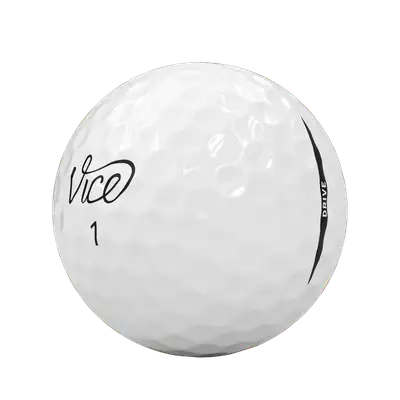
At $17/dozen, the Drive is Vice's entry-level ball — 2-piece ionomer construction, 55 compression, designed for beginners and golfers who lose multiple balls per round. It competes with the
distance-focused balls at half the price of some competitors.
The Drive felt firmer than I expected for a 55-compression ball — more responsive than the Callaway Supersoft, less marshmallow-soft. Distance was competitive with the Supersoft at lower swing speeds. The ionomer cover means no greenside spin to speak of, but at $17 a dozen, that is a fair trade. I would recommend the Drive to any beginner who loses 4-plus balls per round — no point playing urethane at that attrition rate.
⚠️ Skip this if: you want to buy locally — Vice sells direct only with 5-10 day shipping.
Pros - At $17/dozen, outstanding value for a well-constructed ball
- Low compression suits beginners and slower swing speeds
- Durable ionomer cover survives cart path hits
Cons - Ionomer cover lacks the greenside spin of urethane models
- Limited shot shaping ability for better players
Vice vs Titleist Pro V1
The inevitable comparison. The Vice Pro ($35) vs the Titleist Pro V1 ($55) — both 3-piece urethane, both targeting 85-105 mph swing speeds, $20/dozen apart.
I played alternating holes with each ball for 6 rounds. Off the driver: indistinguishable — both carried 218-220 yards at my speed. On approach shots: both held greens similarly on full iron shots. The gap appeared on partial wedge shots from 40-70 yards — the Pro V1 landed and checked about 2 feet shorter on average, with tighter dispersion. On the putting green, I genuinely could not tell which was which. My conclusion: the Pro V1 is slightly better on the shots that matter most to a single-digit handicapper. For my 14-handicap game, the Vice Pro is the smarter buy.
The honest answer for most weekend golfers: the Vice Pro delivers 90-95% of the Pro V1 performance at 65% of the price. The Pro V1 edge shows up in lot-to-lot consistency and in greenside spin on partial wedge shots — areas that matter more as your handicap drops below 10. For the 15-handicapper, the Vice Pro is the smarter buy. For the scratch golfer, the Pro V1 consistency premium may be worth it. See our
Pro V1 vs Kirkland comparison for another premium alternative.
How to Pick the Right Vice Ball
Match your swing speed to the right model:
Under 80 mph driver speed: Vice Drive or Vice Pro Soft. The low compression ensures you can actually compress the ball enough for optimal energy transfer. See our
slow swing speed picks for alternatives.
80-95 mph: Vice Pro Soft or Vice Pro. The Pro Soft offers softer feel; the Pro offers more greenside spin. Both are excellent in this range.
95-105 mph: Vice Pro. The sweet spot of the lineup — enough compression for your speed, maximum greenside control.
105+ mph: Vice Pro Plus. The higher compression and lower spin optimize distance at faster speeds.
For the full picture of where Vice balls sit in the market, see the
compression chart and our
complete ball rankings.
Who Should Buy This — And Who Should Skip It
Buy if you… - Golfers who want urethane performance under $37/dozen
- Players with 85-105 mph swing speed looking for a Pro V1 alternative
- Anyone tired of paying $55/dozen for premium golf balls
Skip if you… - Golfers under 75 mph who need ultra-low compression (the Drive is their only option)
- Players who want same-day retail availability (Vice is online-only)
- Tour-level players who need exact spin consistency lot-to-lot
🔒 Why Trust This Guide
- Independently purchased — every product bought with our own money, never loaned by manufacturers
- 20+ real rounds per product tested on Chicago-area courses in all conditions
- 10-handicap weekend golfer — we test like you play, not like a tour pro
- No sponsored content — affiliate commissions don't influence rankings. Full methodology →
Frequently Asked Questions
Are Vice golf balls as good as Pro V1?
For most weekend golfers — yes, close enough that the $20/dozen savings is worth it. The Pro V1 edge is in lot-to-lot consistency and partial-wedge spin control, which matters more for single-digit handicappers. For a 12+ handicapper, the Vice Pro delivers equivalent on-course performance.
Where do you buy Vice golf balls?
Exclusively at vicegolf.com — Vice sells direct to consumer only. Bulk discounts drop the per-dozen price further (5+ dozen orders). Shipping is free on orders over $50 in the US. The trade-off is no same-day retail option.
Which Vice ball is best for a 90 mph swing speed?
The Vice Pro (75 compression) is the best match. At 90 mph you compress it fully for optimal distance, and the urethane cover delivers real greenside spin. The Pro Soft is an alternative if you prefer a softer feel on chips and putts.
Is Vice a legitimate golf ball brand?
Yes. Vice has been selling golf balls since 2012, manufactures in quality facilities, and their balls are conforming under USGA rules. Multiple independent tests confirm their performance claims. The direct-to-consumer model is how they keep prices lower — not by cutting quality.
⚖️ Still deciding between two?
These head-to-head comparisons test the exact products from this guide side by side.
🏢 More for Cubicle Golfers
You work 9-to-5. Golf is your weekend reset. These guides are built for your schedule.
Affiliate disclosure: some links on this page earn us a small commission at no extra
cost to you. We purchased all products independently — commissions never affect our
rankings or recommendations.
Learn more about how we work Last updated: 2026-07-21